
Read Time: ⏱️ 8 minutes | By: Luca
How Much Does It Cost to Start a Brewery? [2026 Guide]
Section 1: Introduction to Capital Asset Allocation in Modern Beverage Production
Planning the finances of a commercial craft beer startup means making critical choices about your plant and equipment.
New production managers often debate the trade-off between buying used machinery and investing in custom-built factory systems.
This choice often centers on comparing used vs new brewery equipment options to decide which path gets you to profitable operation faster.
Every cellar tank, hot-side vessel, and packaging line you put on the floor affects your debt-to-equity ratio and your starting cash.
If a startup spends its entire credit line on high-end custom brewhouse designs, it may run out of working capital before its first batch is even packaged.
On the other side, choosing low-quality, poorly maintained used lines can quickly lead to unexpected downtime and delays.
To understand the business principles behind asset depreciation and long-term capital management, review Wikipedia: Return on Investment.
Whether you run a small neighborhood taproom or a large industrial packaging floor, your equipment choices set your target margins.
Using a clear financial plan protects your business against sudden maintenance costs and expensive bottlenecks.
The brewery startup cost can vary widely depending on the size of the project, the location, and the type of equipment needed.
Important items such as brewing kettles, fermentation tanks, heat exchangers, cooling systems, and packaging machines can strongly affect the total cost of opening a brewery.
New breweries also need to consider licensing and permits, because legal requirements can change depending on the city, state, or country.
Beyond equipment and paperwork, marketing expenses are also important for building visibility and attracting customers.
A good launch plan may include branding, a website, local promotion, and social media marketing to reach beer drinkers before and after opening.
Managing these costs carefully can help protect the profit margin and make the brewery more stable during its first years.
Building a Complete Startup Budget
A complete brewery startup budget should separate every major expense category.
Typical estimates include $100,000 to more than $1 million for brewery equipment, $50,000 to $250,000 for renovations, $1,000 to $20,000 for permits, $3,000 to $10,000 for branding and marketing, and $5,000 to $15,000 for insurance.
Initial ingredients, packaging materials, cleaning chemicals, spare parts, glassware, furniture, and small tools must also be included. (7shifts)
Large tanks are easy to remember because they dominate the brewery floor.
Smaller expenses are easier to overlook, but together they can consume a significant part of the opening budget.
Build the estimate line by line instead of assigning one general number to “equipment.”
Include every hose, pump, fitting, keg, label, chemical, tool, and replacement part needed for the first production runs.
Section 2: Cellar Analytics and Quality Control Tooling
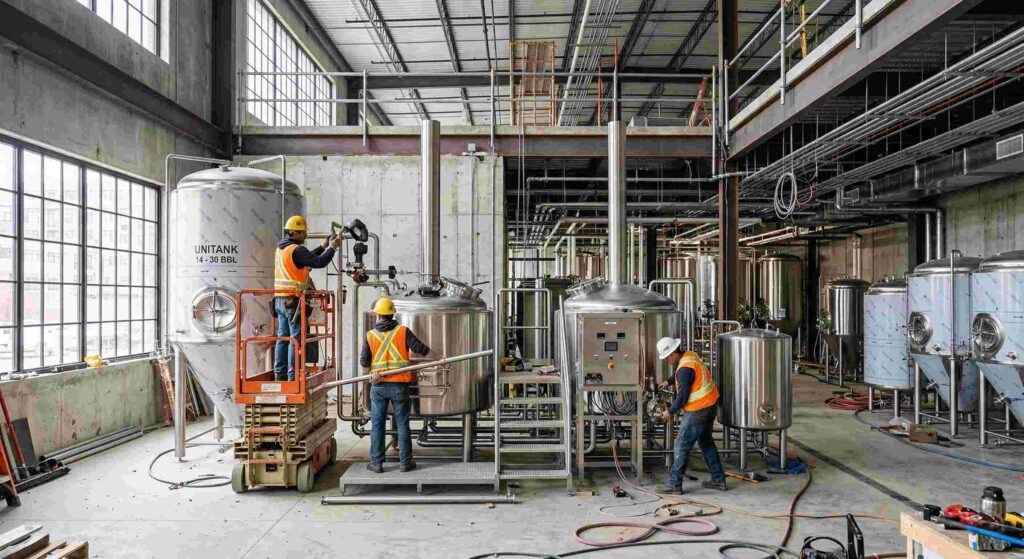
To keep your beer quality consistent across thousands of barrels a year, you need a strong chilling routine in your cellar.
The lab spaces must be equipped to track baseline numbers like dissolved oxygen, microbial counts, and gravity drops.
Investing in a dedicated brewery lab equipment setup lets production managers catch problems long before the beer reaches distribution.
Before any wort moves down the line to the fermentation tanks, the lab team must run detailed quality control checks.
The samples must be examined with precise lab instruments to confirm healthy yeast and a clean fermentation.
A poorly equipped lab can lead to spoilage, off-flavors, and major recalls that ruin brand trust.
To study the biology and chemistry used to keep quality high in modern food production, review Wikipedia: Quality Control.
A dedicated testing setup keeps your base beer free of stress esters, sulfur, and unexpected temperature spikes.
Technology and Software Costs
Technology costs should be included in the brewery startup plan.
A growing brewery may need production management software, inventory tracking, recipe management, accounting tools, employee scheduling, customer relationship management, and a taproom point-of-sale system.
The budget should include hardware, installation, monthly subscriptions, payment processing charges, employee training, and integrations between the production and sales systems.
Spreadsheets can work during the earliest stage, but they become difficult to manage when production, purchasing, inventory, and taproom sales begin changing every day.
Choosing compatible systems from the beginning reduces duplicate data entry and helps the brewery understand what was produced, what was sold, and how much profit each batch generated.
Section 3: The Evolution of Liquid Processing Technology
The machines inside a modern beverage plant are the result of centuries of metallurgical and industrial progress.
When a team reviews the history of brewing, they learn how ancient wooden vessels became modern automated stainless steel systems.
A good multi-stage cellaring system lets managers control all the metabolic heat before yeast pitching begins.
This stable environment gives the team full control over whether a beer turns out crisp and clean or deep and fruity.
Without this control, the heat from active yeast can push the tank core temperature far beyond its ideal range.
A high core temperature pulls harsh fusel alcohols from the sugars, leaving a solvent-like burn in the finished beer.
To explore the early history of food preservation and old fermentation traditions across cultures, see Wikipedia: History of Beer.
With a clean thermal setup, your facility can hit peak flavor in every batch, saving thousands of dollars in lost product each year.
Section 4: Mechanical Integrity and Sanitary Engineering Checks
A modern industrial cellar relies on a precise chain of mechanical and electrical parts to protect its tanks.
Before the wort ever meets the yeast, it passes through a long sequence of mechanical steps.
This cold-side setup usually needs a professional brewery weld inspection/evolution of brewing technology to make sure every joint on the lines is smooth and sanitary.
The inspector checks the lines for tiny cracks, pockets of slag, or rough weld lines.
Any small defect inside a line can trap residue and shield wild bacteria from standard clean-in-place chemicals.
To study the industrial standards used to check metal joints in food-grade piping, explore Wikipedia: Welding.
Finally, the control board reads signals from submerged temperature sensors, which detect small thermal changes instantly.
Section 5: Regulatory Compliance, Audits, and Accountability
Meeting local environmental rules and regional compliance targets means keeping detailed paperwork for every part of your facility.
Making sure your space passes surprise government walkthroughs means following a thorough brewery inspection checklist every day.
Your checklist must confirm correct backflow preventers, safe chemical storage, and automatic temperature cutoff valves.
Failing these safety and sanitation standards can bring immediate fines, forced closures, or long-term legal trouble.
A professional floor also needs enough spare capacity to crash several tanks at once while holding steady cold-room conditions.
Undersizing this utility creates severe scheduling bottlenecks, forcing your crew to wait hours for the cold rooms to catch up.
To study how national agencies monitor factories to protect workers and consumers, see Wikipedia: Food and Drug Administration.
Licensing and Permits
A United States brewery must complete federal, state, and local approval procedures before beginning commercial production.
The federal process normally includes obtaining a Brewer’s Notice from the Alcohol and Tobacco Tax and Trade Bureau.
State requirements may include a manufacturing license, taproom privileges, distribution approval, and alcohol sales permits.
Local approvals can include zoning permission, building permits, fire inspections, wastewater authorization, food service licenses, and certificates of occupancy.
Licensing is not a single application.
It is a chain of approvals involving different authorities, and one missing document can delay the entire opening.
Start the process early and create a calendar showing every application, supporting document, renewal fee, inspection, and expected approval date.
Do not announce the opening until the required permits are confirmed.
Section 6: Procurement Strategies and Supply Chain Logistics
Running a high-capacity plant comes with real environmental duties and strict regional energy rules.
Cooling hot wort down to fermentation temperature creates a large stream of hot water inside the heat exchanger plates.
When outfitting a new floor, founders often choose to import brewery equipment from premium international makers to build out their tank farms.
Managing this global supply route means understanding marine freight schedules, tariff codes, and harbor clearance steps.
Advanced facilities send this pre-heated water into storage tanks, reusing it as hot liquor for the next mash or cleaning loop.
Failing to plan for long shipping times or port delays can stall your build and cause expensive warehouse overhead.
To study how logistics companies handle freight and clear cross-border shipments safely, review Wikipedia: Customs Brokers.
Equipment-Only Price Breakdown
Equipment prices should be presented separately from the total cost of opening the brewery.
Supplier-side estimates place a basic 3–7 BBL nano brewery package at approximately $10,000 to $50,000.
A 10–15 BBL microbrewery equipment package may range from $50,000 to $120,000.
Medium commercial systems between 20 and 50 BBL may cost $120,000 to $300,000, while large automated systems can exceed $300,000 and reach $1 million or more.
These estimates normally exclude the property, installation, freight, taxes, licensing, construction work, staffing, and opening inventory. (hgbeerequipment.com)
An equipment quote is not the same as a complete brewery budget.
Always ask suppliers exactly what the price includes.
A low quotation may cover only the brewhouse and tanks, leaving the buyer responsible for refrigeration, controls, commissioning, freight, spare parts, packaging equipment, and installation.
Section 7: Sizing the Initial Cellar and Selecting Tank Volumes
Designing a reliable fluid line means mounting industrial-grade parts onto a rigid, low-resistance overhead grid.
For mid-size regional taprooms, a standard 7 barrel brewing system/bbl brewery equipment setup gives a good balance of batch flexibility and weekly volume.
This size lets your team run small specialty batches while keeping the core flagship recipes flowing.
Cheap PVC or thin uninsulated flexible lines must be avoided on glycol loops, because they crack easily and sweat constantly.
Balance valves on each tank branch let operators monitor and trim the system’s pressure in real time.
Pressure-relief bypass loops should be installed right after the main pump to handle closed-valve deadhead situations.
To study the engineering math used when scaling vessel sizes in modern manufacturing, see Wikipedia: Chemical Engineering.
Section 8: Financial Forecasting and Capital Budgeting
The final flavor of your beer has a strong, lasting effect on how many customers come back.
When working through your early financial model, calculating how much it costs to start a brewery involves tracking several major cost categories.
These include real estate leasing, drainage upgrades, specialized plumbing, and your main machinery purchases.
As sugar use slows, the team must raise the target temperature to run a proper diacetyl rest.
This warming step lets the yeast reabsorb vicinal diketones, preventing a slick or buttery aroma in the beer.
By starting with a well-controlled cellar program, your team can move smoothly through these biological phases for clean maturation.
To see how small businesses manage their early loans, building costs, and daily cash flow, check Wikipedia: Startup Company.

Working Capital for the First Year
Startup capital should include enough working cash to cover the first six to twelve months of operations.
This reserve pays for payroll, ingredients, packaging, utilities, rent, debt payments, maintenance, insurance, and marketing while sales are still developing.
Calculate the brewery’s monthly burn rate and multiply it by the number of months required before revenue is expected to stabilize.
Working capital should remain separate from the equipment purchasing budget.
A brewery can own excellent equipment and still fail because it runs out of cash before sales become predictable.
Beer takes time to produce, condition, package, distribute, and sell.
During that period, employees, suppliers, landlords, and utility companies must still be paid.
Protecting a cash reserve is therefore just as important as buying the brewhouse.
One-Time vs. Recurring Costs
The brewery budget should separate one-time startup expenses from recurring operating costs.
One-time expenses include lease deposits, construction work, brewing equipment, furniture, licensing applications, professional services, signage, and initial inventory.
Recurring expenses include rent, payroll, utilities, ingredients, packaging, insurance, software subscriptions, waste collection, equipment maintenance, laboratory supplies, and loan repayments.
This separation makes it easier to calculate the capital required to open and the monthly revenue needed to remain operational.
Mixing startup expenses and monthly operating costs can make a business plan look healthier than it really is.
A fermenter may be purchased once, but rent, wages, electricity, cleaning chemicals, and packaging return every month.
Showing the two groups separately gives owners and lenders a much clearer picture of the brewery’s cash requirements.
Labor and Staffing Costs
Labor costs depend on both the production model and the customer-facing services offered by the brewery.
A typical team may include a head brewer, assistant brewers, cellar operators, packaging employees, a taproom manager, servers, sales staff, and administrative support.
Estimated annual salaries can range from $45,000 to $85,000 for a head brewer, $35,000 to $50,000 for assistant brewers, and $40,000 to $60,000 for a taproom manager.
The full labor budget must also include payroll taxes, employee benefits, training, overtime, workers’ compensation, and seasonal staffing. (Menubly)
The salary shown in a job advertisement is not the full cost of hiring that employee.
Breweries must also budget for training, payroll taxes, insurance, protective equipment, overtime, and coverage during holidays or illness.
A realistic staffing plan should show the total cost of each role, not only the base wage.
Section 9: Structured Project Milestones for Facility Development
Every classic beer style grew directly from the specific conditions found in its region of origin.
Laying out the clear steps to start a brewery keeps your project moving from the early business plan to opening day.
These steps include securing federal wastewater permits, laying thick antimicrobial floor coatings, and tuning your automated glycol chillers.
By contrast, a true Belgian Saison needs a warm space allowed to rise past 80 degrees Fahrenheit, which brings out spicy phenolics.
With a multi-zone control panel, your team can run a warm ale on tank one and a cold lager schedule on tank two.
This flexibility lets a single plant make a wide range of world-class beers without quality drop-offs.
To review the project management tools used to guide complex construction to completion, look at Wikipedia: Project Management.
Property and Facility Costs
Facility costs should be calculated according to the condition of the property, not only its monthly rent.
Converting an existing brewery is usually less expensive than adapting a standard warehouse or retail unit.
A new location may require reinforced floors, trench drains, upgraded electrical service, gas connections, ventilation, water treatment, and additional fire safety systems.
As an initial benchmark, brewery properties may cost between $10 and $30 per square foot before specialized production upgrades are included. (Toast POS)
A cheap lease can quickly become an expensive mistake when the building is not ready for brewery operations.
Before signing, ask contractors to inspect the drainage, electrical capacity, ceiling height, floor loading, ventilation, and access points for large tanks.
The real cost of the property is the rent plus everything required to make it usable.
The Contingency Reserve
A brewery startup budget should include a contingency reserve equal to approximately 10% to 20% of the planned project cost.
This reserve can absorb permit delays, construction changes, utility upgrades, freight increases, installation problems, replacement parts, and additional professional fees.
The contingency fund should not be used to purchase optional equipment unless the construction and commissioning stages have been completed without unexpected expenses. (YoLong Brewtech)
Almost every brewery project discovers something that was not visible in the original quotation.
It may be an electrical panel that needs replacing, a drain that must be relocated, or a tank that requires a different fitting.
Keeping a separate contingency reserve prevents these surprises from stopping the entire project.
Section 10: Selecting the Optimal Business Model for Long-Term Profitability
Choosing how to source your refrigeration assets means balancing your startup cash against your long-term maintenance costs.
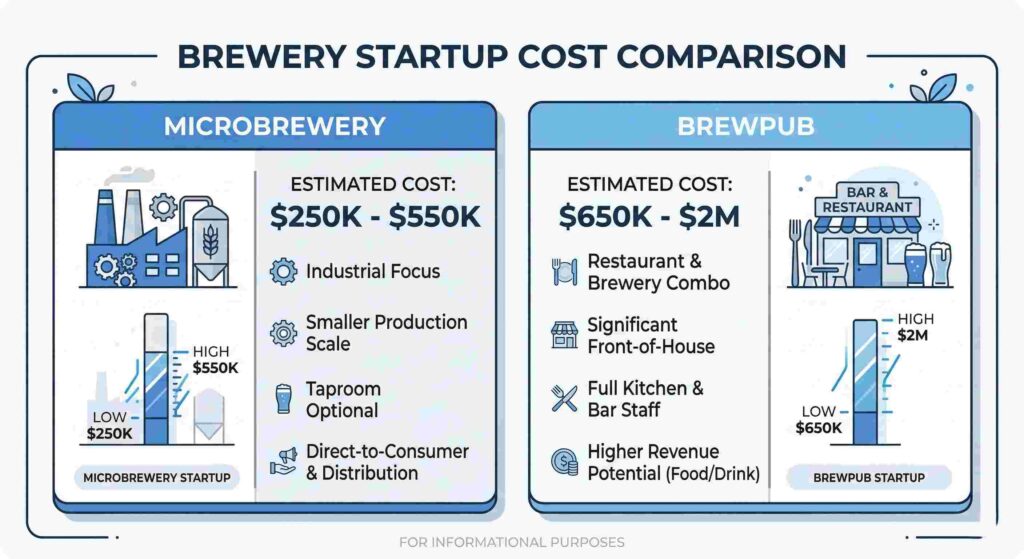
Entrepreneurs must weigh the pros and cons of launching a microbrewery or brewpub model to match their local market.
A microbrewery model focuses on high-volume packaging and wholesale distribution to drive revenue through regional retail shelves.
A brewpub relies on high-margin on-site taproom sales, combining house-brewed drinks with full kitchen food service to maximize profit.
New custom-built systems include full manufacturer warranties, direct technical support, and modern automated wiring that meets local code.
To balance these factors, buying a new core chiller skid while sourcing secondary fittings and storage tanks used is a common strategy.
Whatever your sourcing path, checking the electrical safety and reliability of every compressor prevents expensive product losses later.
Contract Brewing as a Lower-Capital Route
Contract brewing can provide a lower-capital route for entrepreneurs who want to test a beer brand before building a complete production facility.
Under this model, an established brewery produces the beer while the new company focuses on branding, sales, distribution, and customer development.
The arrangement reduces the initial investment in tanks, refrigeration, utilities, and production space.
However, it also reduces control over scheduling and production and normally leaves a lower margin on every unit sold.
Not every beer company needs to build a complete brewery on day one.
Contract brewing allows founders to test recipes, pricing, packaging, and customer demand before committing millions of dollars to a permanent facility.
The savings should be compared with the lower margins and reduced production control.
A separate break-even calculation should show how many barrels, kegs, cans, or taproom pints must be sold each month to cover rent, payroll, financing, and other fixed costs. (National Retail Solutions)
Section 11: Capital Expenditure Comparison Matrix
Picking your asset mix means balancing upfront equipment costs against your long-term efficiency goals.
The table below compares the typical costs and working lifespans of different equipment options:
| Equipment Strategy Option | Typical Initial Cost Allocation | Mechanical Life Expectancy | Warranty & Service Levels |
| Used Broker Equipment | 40% to 60% of New Retail | 3 to 7 Operational Years | As-Is / No Manufacturer Support |
| Direct European Import | 85% to 110% of New Retail | 15 to 25 Operational Years | Limited Overseas Parts Warranties |
| Domestic Custom Built | 100% to 130% of New Retail | 20 to 30 Operational Years | Full Comprehensive Local Support |
| Turnkey Automated Skids | 120% to 150% of New Retail | 20+ Highly Efficient Years | 24/7 Remote Monitoring Support |
Section 12: Metallurgical Integrity and Clean-In-Place Loops
The chemistry between your steel jackets, cleaning agents, and tanks affects how long your equipment lasts.
Commercial cellar tanks must be built from premium austenitic stainless steel, usually AISI 304 or acid-resistant AISI 316L.
These alloys have high chromium and nickel, which form a passive oxide layer that protects the metal.
This passive layer protects your tanks from cleaning acids, hot sanitizing solutions, and strong internal fluid forces.
To stop wild microbes from taking hold, the inside steel must be polished to a smooth finish with a low roughness average.
Any rough patches, weld lines, or tiny scratches can hide residue and protect wild bacteria from standard cleaning.
To keep the high sanitary standards the floor needs, maintenance must follow strict sanitizing loops.
Section 13: Facility Safety and Refrigerant Containment
Running an industrial cellar means balancing high pressures and special chemicals with strict local environmental laws.
The high-pressure lines and dense refrigerants inside your condensers cannot leak into your workspace.
To meet local safety laws, modern facilities must install a dedicated refrigerant leak-detection system.
This system samples the air near your compressors and uses sensors to trigger alarms automatically if levels spike.
Your floor crew must also wear full personal protective equipment, including electrical safety gear, heavy gloves, and face protection during line service.
By making safety and environmental compliance a priority, you protect your staff and keep the facility running without legal delays.
Section 14: Final Summary and Operational Growth Blueprint
Choosing your core equipment means a clear view of your regional sales goals, your space, and your upfront capital.
If your venue runs a taproom model where inventory moves fast on-site, a compact automated chiller skid is an affordable path.
But if your goal is expanding wholesale lines across several states, a fully integrated multi-compressor system is essential.
Be sure to check your building’s floor weight limits, balance your glycol concentrations, and enforce strict automated checks.
By choosing the right equipment for your volume goals and treating your control setup as a vital partner, your team will deliver great products.