
Read Time: ⏱️ 5 minutes | By: Luca
Microbrewery or Brewpub: Which Should You Open in 2026?
Section 1: Planning Your Equipment Budget
Setting up a commercial craft beer startup means making big choices about your physical equipment.
Founders often debate whether to buy used machinery or invest in custom-built factory systems.
This choice often comes down to comparing used vs new brewery equipment to see which path gets you to profit faster.
Every cellar tank, hot-side vessel, and packaging line you add affects your debt and your cash reserves.
If a startup spends its entire credit line on high-end custom brewhouses, it may run out of working capital before its first batch is packaged.
But choosing cheap, poorly maintained used lines can quickly lead to breakdowns and production delays.
To understand how equipment loses value over time and how to manage these assets, review Wikipedia: Return on Investment.
Whether you run a small taproom or a large packaging floor, your equipment choices decide your profit margins.
A clear financial plan keeps your business protected against sudden maintenance costs and production bottlenecks.
Defining Microbrewery vs. Brewpub
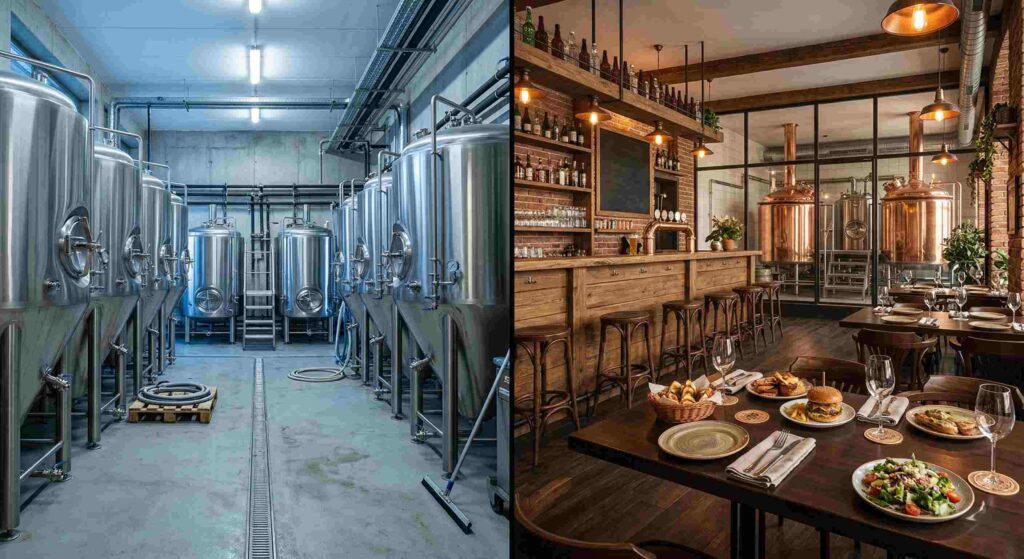
The distinction between a microbrewery and a brewpub is based on more than the presence of brewing equipment.
A microbrewery generally produces fewer than 15,000 barrels per year and sells most of its beer away from the production site. A brewpub, by contrast, combines brewing with a restaurant operation and sells a significant share of its beer directly to customers on the premises.
Before choosing either model, founders should decide where most of their beer will actually be sold.
If the plan depends on retailers, bars, and regional distribution, a microbrewery may be the better fit. If customers will mainly drink the beer while dining at the venue, the business is much closer to a brewpub.
Understanding Your Target Customer
The target customer also changes between the two models.
A microbrewery can focus on beer enthusiasts, limited releases, tasting events, brewing education, and distinctive product stories. A brewpub normally needs broader appeal because it must attract diners, families, groups, and customers who may choose the venue primarily for food or atmosphere.
A microbrewery can build a loyal following around unusual styles and conversations with the brewer.
A brewpub usually needs to satisfy a wider group. One person may want a seasonal IPA, while another may care more about the menu, service, seating, or family-friendly atmosphere.
Section 2: Lab and Quality-Control Tools
To keep your beer consistent across thousands of barrels a year, you need a steady quality-control routine in your cellar.
Your lab space should be able to track basic measurements like dissolved oxygen, microbial counts, and gravity readings.
Investing in good brewery lab equipment lets your team catch problems long before the beer reaches distribution.
Before the beer moves toward the fermentation tanks, the lab team should run detailed quality checks.
Samples should be examined with proper lab instruments to confirm healthy yeast and clean fermentation.
Skipping a proper lab setup can lead to spoilage, off-flavors, and recalls that damage your brand.
To learn the basic science behind quality control in food production, review Wikipedia: Quality Control.
A dedicated testing area keeps your beer free of stress flavors, sulfur notes, and unexpected temperature swings.
Section 3: How Brewing Technology Has Evolved
The machines inside a modern brewery are the result of centuries of steady improvement.
When a team looks at the history of brewing and the evolution of brewing technology, they see how simple wooden vessels became modern automated stainless steel systems.
A good temperature-control system lets your team manage the heat that fermentation produces before the yeast is even pitched.
This stable environment gives the brewer control over whether the beer turns out crisp and clean or rich and fruity.
Without that control, the heat from active yeast can push the tank temperature far too high.
A too-warm fermentation creates harsh fusel alcohols, leaving the beer with a solvent-like burn.
To explore the early history of fermentation and food preservation, see Wikipedia: History of Beer.
With good temperature control, every batch can reach its best flavor, saving thousands of dollars in lost product each year.
Section 4: Checking Welds and Sanitary Design
A modern brewery relies on a precise set of mechanical and electrical parts to protect its tanks.
Before the wort ever meets the yeast, it passes through several mechanical steps.
This cold-side setup usually calls for a professional brewery weld inspection to make sure every joint is smooth and sanitary.
The inspector checks the lines for tiny cracks, slag pockets, or rough weld seams.
Any small defect inside a line can trap residue and shield bacteria from normal clean-in-place cycles.
To learn the standards used to check metal joints in food-grade piping, explore Wikipedia: Welding.
The control board also reads signals from submerged temperature sensors, which detect small thermal changes instantly.
Section 5: Rules, Licensing, and Inspections
Meeting local safety rules and compliance targets means keeping detailed paperwork for every part of your facility.
To make sure your space passes surprise government visits, follow a thorough brewery inspection checklist every day.
Your checklist should confirm proper backflow preventers, safe chemical storage, and automatic temperature cutoff valves.
Failing these safety and sanitation standards can bring fines, forced closures, or long-term legal trouble.
A professional production floor also needs enough spare cooling capacity to crash several tanks at once while keeping cold storage steady.
Undersizing this utility creates serious scheduling bottlenecks, forcing your crew to wait hours for the cold rooms to settle.
To learn how national agencies watch manufacturing sites to protect workers and consumers, see Wikipedia: Food and Drug Administration.
The Legal Structure and Licensing
The legal structure of the business should be checked before selecting the building or purchasing equipment.
A brewpub may require a retail restaurant or bar license together with authorization to manufacture beer. A production microbrewery normally operates under a manufacturing license, with separate permissions governing taproom sales, packaged beer, self-distribution, and sales to wholesalers.
These rules vary significantly between states and municipalities.
Calling a business a brewpub does not automatically give it permission to serve food, sell beer by the glass, or distribute packaged products.
The license determines what the company can actually do. Founders should confirm every permitted sales channel before committing to a business model.
Reviewing Distribution Franchise Laws
A production microbrewery should review state franchise laws before signing a distribution agreement.
In some markets, changing or terminating a wholesaler relationship can be difficult and expensive. The contract should clearly define territory, performance expectations, minimum sales activity, brand ownership, termination conditions, reporting requirements, and responsibility for unsold or expired products.
Choosing a distributor can become a long-term decision rather than a simple sales arrangement.
A partner who looks suitable during the launch may become difficult to replace later. Legal review before signing can protect the brewery from being trapped in an underperforming relationship.
Section 6: Importing Equipment and Choosing a Location
Running a high-capacity brewery comes with real environmental and energy responsibilities.
Cooling hot wort down to fermentation temperature produces a large stream of hot water inside the heat exchanger.
When outfitting a new floor, founders often import brewery equipment from top international makers to build out their tank farms.
Managing that global supply chain means understanding shipping schedules, tariff codes, and customs clearance.
Smart facilities divert the pre-heated water into storage vessels and reuse it as hot liquor for the next mash or cleaning cycle.
Failing to plan for long shipping times or port delays can stall construction and drive up overhead costs.
To learn how logistics companies handle freight and clear cross-border shipments, review Wikipedia: Customs Brokers.
Choosing the Right Location
The two business models require different location priorities.
A brewpub benefits from visibility, pedestrian traffic, parking, nearby entertainment, and easy access for families and groups. A production-focused microbrewery may prioritize affordable industrial space, loading access, ceiling height, utility capacity, warehouse storage, and efficient delivery routes.
The cheapest industrial building may work perfectly for production but poorly for a restaurant.
Likewise, a busy downtown location may attract customers while creating serious problems for tank installation, deliveries, wastewater handling, and future expansion. The location must support the chosen revenue model.
Section 7: Sizing Your Cellar and Your Team
Designing a reliable fluid layout means mounting industrial-grade parts onto a rigid support frame.
For a mid-size regional taproom, a standard 7-barrel system offers a good balance of flexibility and weekly volume.
This size lets your cellar team run small specialty batches while keeping the core flagship beers flowing.
Avoid cheap PVC or thin uninsulated lines on glycol loops, because they crack easily and sweat constantly.
Balance valves on each tank branch let operators monitor and adjust the system’s pressure in real time.
Pressure-relief bypass loops should sit right after the main pump to handle closed-valve situations quickly.
To learn the engineering math used when scaling vessel sizes, see Wikipedia: Chemical Engineering.
Staffing a Brewpub’s Two Teams
A brewpub requires two specialized teams operating inside the same business.
The brewing team manages production, fermentation, quality control, packaging, and equipment maintenance. The restaurant team handles cooking, food safety, table service, reservations, cleaning, and customer experience.
Payroll forecasts must include both teams, as well as managers capable of coordinating production and hospitality operations.
Opening a brewpub means running a brewery and a restaurant at the same time.
A skilled brewer cannot automatically manage a busy kitchen, and an experienced restaurant manager may know very little about cellar scheduling. Clear responsibilities and strong coordination are essential.
Section 8: Budgeting and Financial Forecasting
The final flavor of your beer has a lasting effect on whether customers come back.
When you build your early financial model, working out how much does it cost to start a brewery means tracking several major cost categories.
These costs include real estate, water drainage upgrades, specialized plumbing, and your main machinery.
As fermentation slows, the team should raise the temperature to run a proper diacetyl rest.
This warming step lets the yeast reabsorb compounds that would otherwise leave a slick, buttery aroma in the beer.
By starting with good temperature control, your team can move through these stages smoothly toward clean maturation.
To learn how small businesses handle loans, building costs, and cash flow, check Wikipedia: Startup Company.

Measuring Taproom and Distribution Separately
On-site sales and distribution should be measured as separate business units.
The financial plan should calculate revenue, gross margin, operating expenses, and EBITDA per barrel for each sales channel. Taproom sales generally produce more revenue per barrel, while distribution provides greater market reach but requires the brewery to surrender part of its margin.
Separate accounting makes it easier to identify which side of the business is actually profitable.
A brewery can sell a large amount of beer and still struggle financially if its distribution margins are too small.
Tracking taproom and wholesale results separately shows whether growth is creating real profit or simply adding production work, delivery costs, and administrative complexity.
The Taproom: A Third Option
A taproom brewery can provide a third option between a distribution-focused microbrewery and a full brewpub.
This model sells beer directly at the production site but avoids operating a complete restaurant kitchen. Depending on local regulations, food may be provided through delivery partnerships, food trucks, pop-ups, or a small independent vendor.
The model can preserve direct-sale margins while reducing kitchen equipment, staffing, and food-inventory requirements.
The decision does not always have to be limited to microbrewery or brewpub.
A taproom can give customers a place to drink directly at the brewery without forcing the owners to manage a full restaurant. For many small producers, this creates a useful balance between margin, customer contact, and operational simplicity.
Section 9: Planning the Project, Step by Step
Every classic beer style developed because of the specific conditions found in its home region.
Carefully outlining the steps to start a brewery and the right bbl brewery equipment keeps your project moving from the first business plan to opening day.
These steps include securing wastewater permits, laying antimicrobial floor coatings, and tuning your glycol chillers.
An authentic Belgian Saison, for example, needs a warm fermentation above 80 degrees Fahrenheit to bring out spicy phenolics.
With a multi-zone control panel, your team can run a warm ale on one tank and a cold lager on another at the same time.
This flexibility lets a single plant make a wide range of quality beers without losing consistency.
To review the project-management tools used to guide complex builds to completion, look at Wikipedia: Project Management.
A craft brewery is often built around creativity, local identity, and a strong connection with the community.
Through craft brewing, each brewing company can create unique recipes that reflect its style and place in the beer scene.
As production grows, the brewery may produce more barrels of beer and become a regional brewery, reaching more beer lovers and beer drinkers while still keeping quality and character at the center of every batch.
Section 10: Choosing the Right Business Model
Choosing how to source your main refrigeration equipment means balancing your startup budget against long-term maintenance.
Founders must weigh the pros and cons of launching a microbrewery or brewpub model to match their local market.
A microbrewery focuses on high-volume packaging and wholesale distribution to earn revenue through regional retail shelves.
A brewpub relies on high-margin on-site taproom sales, pairing house-brewed drinks with full kitchen food service.
New custom systems come with full warranties, direct support, and modern wiring that meets local codes.
A common strategy is buying a new core chiller skid while sourcing used piping and storage tanks.
Whatever path you choose, checking the electrical safety and reliability of every compressor prevents costly losses later.
Different Ways to Offer Food
A full commercial kitchen is not the only way to offer food at a brewery.
Possible models include an internal kitchen, a limited counter-service menu, rotating food trucks, restaurant pop-ups, or a permanent partnership with an independent food operator. Each option has different requirements for equipment, staffing, permits, waste management, and customer service.
Founders who want the atmosphere of a brewpub do not always need to build and manage an expensive kitchen from day one.
A reliable food partner or a carefully planned food-truck program can keep customers at the venue longer while allowing the brewery team to concentrate on making and selling beer.
The Brewpub as a Marketing Channel
A brewpub can function as a permanent marketing channel for the brewery.
Customers experience the beer together with the venue’s food, service, interior design, and atmosphere. This direct interaction helps the business collect feedback, introduce new styles, build loyalty, and communicate its identity without relying entirely on retailers or distributors.
At a brewpub, the company controls the complete experience surrounding every pint.
Instead of hoping that a retailer explains the product correctly, the brewery can tell its own story, recommend food pairings, test new releases, and speak directly with the people drinking the beer.
Section 11: Equipment Cost Comparison Table
Choosing your equipment means balancing upfront cost against long-term operating efficiency.
The table below compares the typical cost and operating life of different equipment options:
| Equipment Strategy Option | Typical Initial Cost Allocation | Mechanical Life Expectancy | Warranty & Service Levels |
| Used Broker Equipment | 40% to 60% of New Retail | 3 to 7 Operational Years | As-Is / No Manufacturer Support |
| Direct European Import | 85% to 110% of New Retail | 15 to 25 Operational Years | Limited Overseas Parts Warranties |
| Domestic Custom Built | 100% to 130% of New Retail | 20 to 30 Operational Years | Full Comprehensive Local Support |
| Turnkey Automated Skids | 120% to 150% of New Retail | 20+ Highly Efficient Years | 24/7 Remote Monitoring Support |
Section 12: Steel Quality and CIP Cleaning
The way your cleaning agents react with your steel tanks affects how long your equipment lasts.
Cellar tanks must be built from high-grade stainless steel, usually AISI 304 or the more acid-resistant AISI 316L.
These alloys contain plenty of chromium and nickel, which form a protective oxide layer over the metal.
This layer protects your tanks from cleaning acids, hot sanitizing solutions, and strong internal forces.
To stop bacteria from taking hold, the inside steel must be polished to a smooth, low-roughness finish.
Any rough spots, weld lines, or scratches can trap residue and hide bacteria from normal cleaning cycles.
To keep the high sanitary standards a production floor needs, maintenance must follow strict cleaning loops.
Section 13: Safety and Refrigerant Systems
Running an industrial cellar means handling high pressures and special chemicals under strict local laws.
The high-pressure lines and refrigerants inside your condenser units cannot be allowed to leak into the workspace.
To follow local safety laws, modern facilities install a dedicated refrigerant leak-detection system.
This setup samples the air near your compressors and triggers alarms automatically if levels spike.
Your floor crew also needs full protective gear, including electrical safety equipment, heavy gloves, and face protection during servicing.
By making safety and the environment a priority, you protect your staff and keep the facility running without legal delays.
Section 14: Summary and Growth Plan
Choosing your core setup starts with a clear view of your sales goals, your space, and your budget.
If you run a taproom model where beer sells quickly on-site, a compact automated chiller skid is an affordable path.
But if your goal is wholesale distribution across several states, a fully integrated multi-compressor system is essential.
Be sure to check your building’s floor-weight limits, balance your glycol concentrations, and enforce strict testing routines.
By matching your equipment to your volume goals and treating your cooling system as a key partner, your team can keep delivering great beer.
Author | Operations & Sourcing Lead
Luca is an operations and sourcing specialist with extensive experience in project management and industrial manufacturing. This blog serves as a technical resource for brewery owners, offering clear guidance on equipment design, quality control, and supplier evaluation. In parallel, Luca advises international buyers on sourcing and importing brewing equipment—helping them manage risk, avoid costly mistakes, and achieve consistent production quality.