
Read Time: ⏱️ 10 minutes | By: Luca
Section 1: Why Brewery CIP Chemicals Matter
Running a commercial brewery means taking cleaning and hygiene very seriously.
For years, cleaning meant taking apart long runs of stainless steel pipe by hand.
That old method created bottlenecks and added hundreds of labor hours to every week.
The right brewery cip chemicals changed how breweries clean their pipes and tanks.
Instead of scrubbing by hand, automated systems circulate special cleaning chemicals through sealed loops.
This keeps every liquid-contact surface free of yeast deposits, beer stone, and wild bacteria.
Picking the right chemicals takes an understanding of chemistry, surface tension, and concentration.
Whether you run a taproom or a big plant, your choice of chemicals shapes your costs.
This guide breaks down the alkaline, acid, and sanitizer chemicals used in modern breweries.
Section 2: Automation and the Cleaning Loop
Moving away from manual cleaning means installing a modern automated CIP system on your floor.
The core system uses high-pressure pumps, pneumatic valves, steam heat exchangers, and sensors run by a central PLC.
The PLC doses the concentrated chemicals into the wash stream based on live conductivity readings.
By letting the software control flow and dosing, your cleaning loops run the same way every day.
Automation removes human error, preventing chemical accidents and ruined batches.
The controller watches flow meters and temperature sensors and adjusts the pumps to hold the right spray pattern.
If the chemical strength drops anywhere in the loop, the system corrects the dosing right away.
For automated-control standards, teams consult the European Hygienic Engineering & Design Group (EHEDG).
Why CIP Cleaners Must Be Low Foaming
Chemicals used in a CIP loop should be low-foaming.
In clean-in-place, the cleaner is pumped fast through pipes and spray balls, so a high-foaming chemical creates problems.
Too much foam reduces contact between the liquid and the surface, cushions the spray, and can cause pump cavitation.
Low-foaming cleaners keep the liquid moving with full scrubbing force.
A cleaner that foams heavily may work fine in a bucket but fail inside a fast CIP circuit.
Foam also makes it hard to see the true liquid level in the tanks.
Choosing a low-foaming formula keeps the whole loop stable and effective.
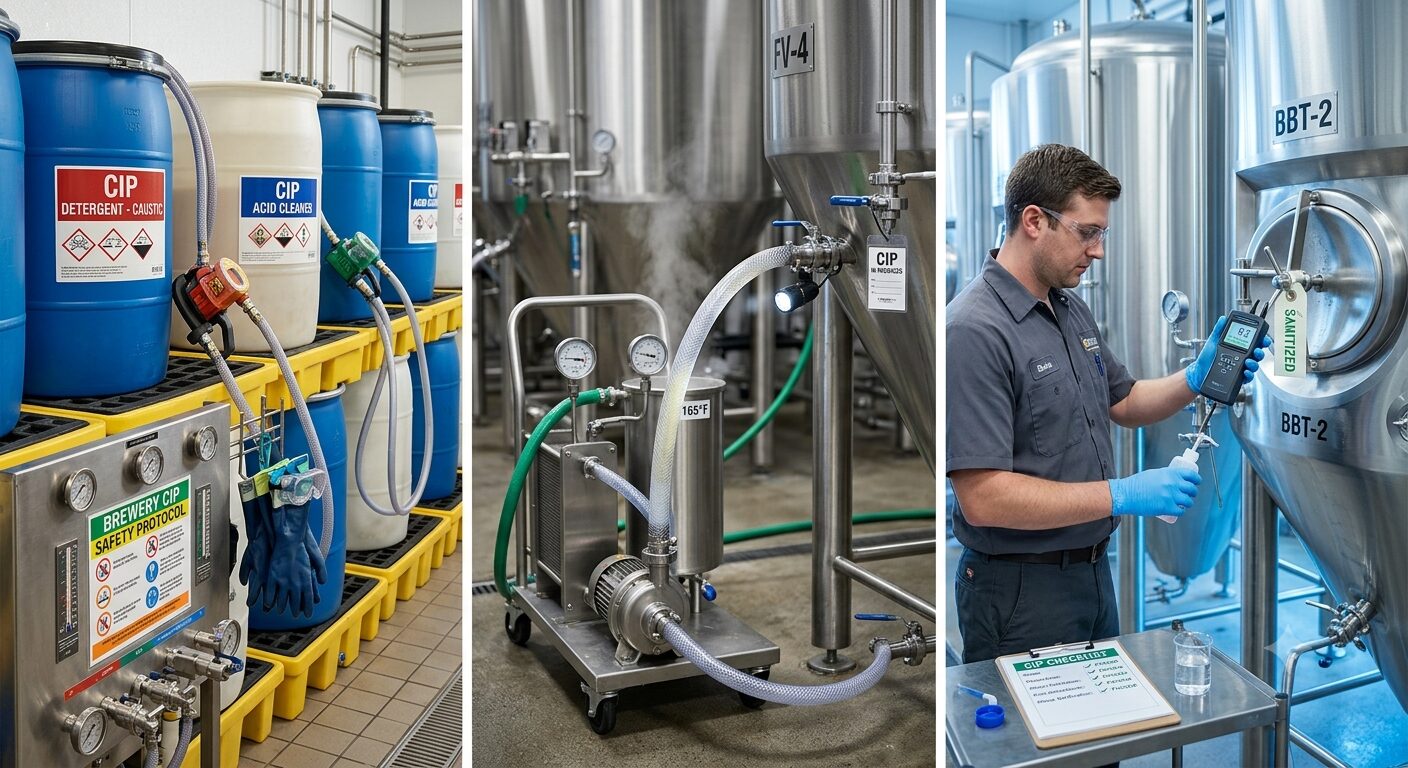
Section 3: The Chemistry of Cleaning
To protect your beer’s flavor over long supply chains, you need strong biological control.
Modern cip brewing works by combining fast fluid movement with strong chemical cleaners.
When hot wort or juice runs across steel, it leaves organic soils that shelter microbes.
If those soils are not dissolved during the wash, bacteria like Lactobacillus quickly take hold.
These infections cause off-flavors, cloudiness, and pressure spikes that hurt your reputation.
An automated loop drives cleaners deep into hard-to-reach spots like valve seats and welds.
The high-speed flow shears the pipe walls, lifting the films and sweeping them to the drain.
For the biology behind wild yeast and hygiene, see the American Society of Brewing Chemists (ASBC).
Remove Carbon Dioxide Before a Caustic Wash
Caustic soda is neutralized by carbon dioxide, so kegs and tanks should be vented before a caustic wash.
If a tank still holds carbon dioxide, the gas reacts with the caustic and weakens it.
A short venting or pre-rinse step removes the gas so the caustic works at full strength.
This is easy to overlook, but it directly affects how well the wash cleans.
A tank that looks empty can still hold pressure and gas.
Releasing that gas first stops it from quietly using up your caustic.
The result is a stronger clean and lower chemical waste.
Sequestering Agents for Hard Water
In hard-water areas, cleaning chemicals should include sequestering agents.
Hard water carries calcium and magnesium, which can react with cleaners and leave scale on surfaces.
Sequestering agents (chelators) lock up these minerals so they cannot form deposits or block the cleaner.
This keeps the caustic and acid working and prevents mineral film inside the tanks.
Without sequestrants, hard water slowly builds scale even in a clean system.
The agents let one chemical handle both soil and water hardness.
This matters most for breweries on hard municipal or well water.
Non-Caustic Alkaline Cleaners
Not every alkaline clean needs strong caustic soda.
Non-caustic alkaline cleaners use milder alkaline salts and additives to remove soils with less hazard.
They are gentler on soft metals like aluminum and safer for staff to handle.
For lighter soils or sensitive equipment, they can replace harsh caustic while still cleaning well.
Strong caustic is powerful but aggressive and dangerous.
A non-caustic option can do the job on lighter loads with less risk.
Matching the cleaner strength to the soil avoids wasting harsh chemicals where they are not needed.
Oxidizing Additives for Difficult Organic Soil
Some heavy organic soils need an oxidizing additive to break them down.
Additives such as peroxide or percarbonate boost an alkaline cleaner’s power against tough films and stains.
The oxidizer attacks organic bonds that plain caustic struggles to remove, like heavy protein or color stains.
This is useful for kettles and vessels with baked-on or stubborn soil.
Sometimes a standard caustic wash leaves a faint stain or film behind.
An oxidizing boost clears that last layer without a longer, hotter cycle.
Used carefully, these additives raise cleaning power without extra scrubbing.
Section 4: The Economics of CIP vs Manual Cleaning
Deciding how to split cleaning between manual work and automated loops means looking at the numbers.
Running a real comparison of manual cleaning vs cip brewery helps directors plan long-term growth.
Manual spray-down needs constant labor, wastes water, and exposes your crew to chemicals.
It also cannot safely reach the high walls of large tanks.
A sealed automated loop uses far less chemical because it recirculates the solution over time.
By cutting tank turnaround from six hours to forty-five minutes, you fit more batches into each week.
That jump in equipment use lets growing brands scale up without buying more fermentation tanks.
Section 5: Single-Use vs Recirculating Systems
The best design depends on your water costs, space, and batch volumes.
A brewery cip system can be built as a single-use loop or a recirculating multi-tank setup.
Single-use designs push fresh water and chemicals through once, then straight to the drain.
This avoids cross-batch contamination but uses a lot of water and chemicals.
Recirculating multi-tank systems capture and store the rinses and caustic for reuse.
That needs a bigger upfront investment but cuts running costs by up to forty percent.
For plants running multiple shifts a day, recirculating is the most cost-effective path.
Section 6: Mobile CIP Carts for Small Breweries
For brewpubs, labs, or startups, a big fixed skid may not fit the space or budget.
A mobile cip cart lets your crew roll professional cleaning power to any tank.
These carts have two compact steel tanks, a high-pressure pump, and electric heating.
The team moves the cart through tight tank rows and connects hoses to make a closed loop.
This lets small breweries automate tank washing without fixed pipelines.
The return pump keeps heavy solution flowing out of the tank base, preventing pooling.
A heavy-duty cart brings industrial cleaning to a small-scale budget.
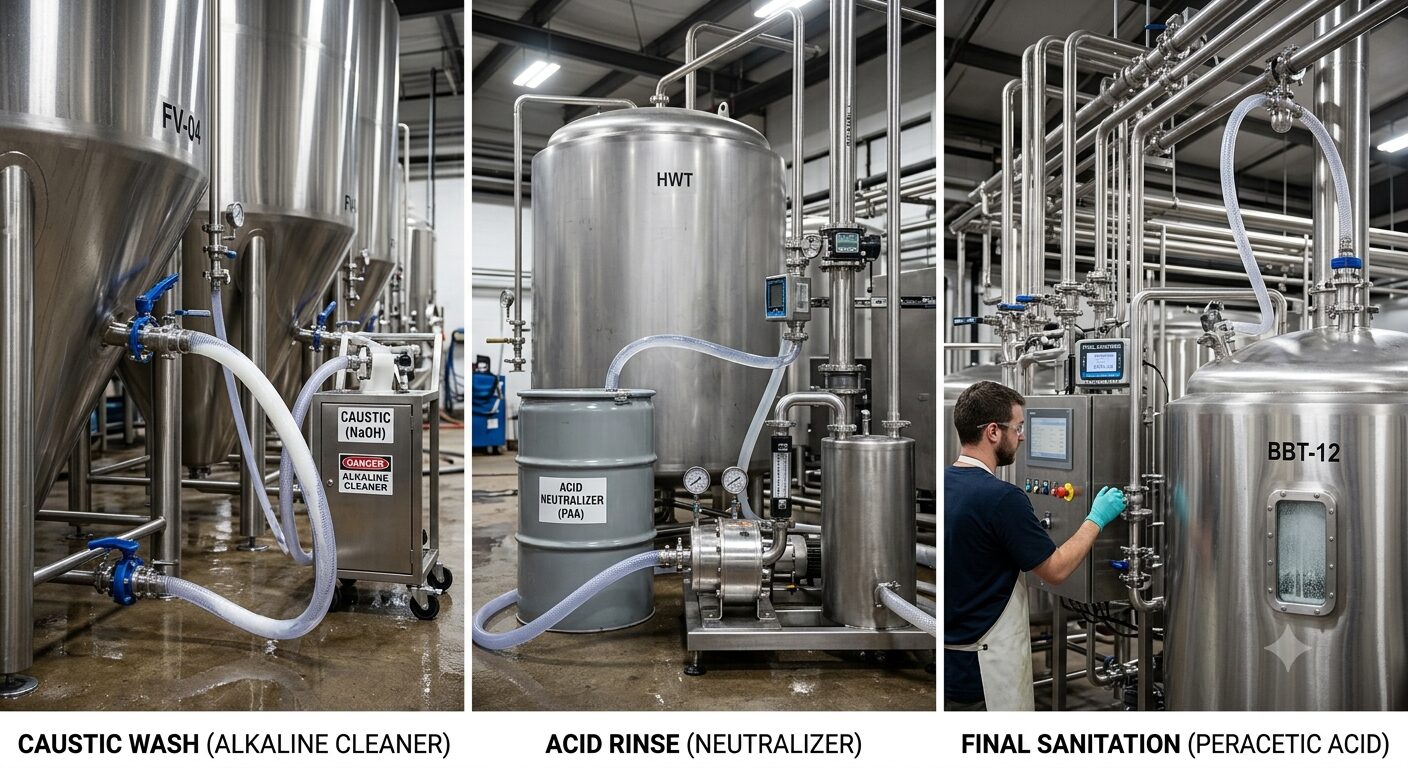
Section 7: Flow and Kinetic Energy in CIP Circuits
Good cleaning depends on the right liquid velocity through the loop.
Biological soils are the enemy of your beer, so the loop must scrub every surface.
To protect flavor, the system uses a sealed clean in place process inside the pipelines.
It locks onto the process lines and runs a multi-stage program.
It clears the air and replaces it with inert gas, then drives the cleaner at the right velocity to scrub the tank walls.
The flow shears the surfaces and sweeps the soils to the drain, with no splashing.
For flow-balance calculations and pressure charts, see the Brewers Association.
Section 8: Quality Assurance and Validation
To confirm your loops actually work, set up a strict cip cleaning validation routine.
You cannot just look at a sealed steel pipe and trust it is sterile inside.
Modern validation uses ATP bioluminescence swabs to detect trace organic material instantly.
The team samples the final rinse and reads it on a digital luminometer.
If the reading is high, the system flags the loop as failed and forces a re-wash.
Regular validation keeps your cleaning at the standard needed for wholesale.
For balancing validation with product quality, teams consult the Siebel Institute of Technology.
Test Strips and Riboflavin Coverage Testing
Simple tools can check both chemical strength and spray coverage.
Test strips confirm the concentration of caustic, acid, or sanitizer in seconds, so you know the chemical is at the right strength.
A riboflavin coverage test coats the inside of a tank with a fluorescent solution, runs the wash, then uses UV light to reveal any spots the spray missed.
Together they check the two big questions: is the chemical strong enough, and did it reach every surface?
ATP swabs show whether a surface is clean, but not why a spot failed.
A riboflavin test shows exactly where the spray ball did not reach.
Used with strips, it turns cleaning from a guess into a checked result.
Section 9: Standard Operating Procedures
A world-class brewery organizes its cleaning into a clear set of brewery cleaning procedures.
This plan lists the exact chemical strengths, water volumes, and loop times for every vessel.
Bright tanks, wort chillers, yeast brinks, and fermenters each need their own wash profile.
A kettle needs a long, hot caustic wash for caramelized sugars, while a bright tank needs a low-temperature cycle to keep its gas pressure.
Your crew should log every cycle: temperature, concentration, and validation score.
Good records help find bottlenecks and trace any quality issue fast.
For safe wash temperatures and staff safety, the Master Brewers Association of the Americas (MBAA) has full cellar guides.
Planning the Frequency of Acid Washes
How often you run an acid wash depends on your water and your process.
Acid wash frequency is driven by water hardness, production volume, and how your caustic wash is run.
Hard water and heavy production build mineral scale and beer stone faster, so they need more frequent acid cycles.
A brewery on soft water with light volume can acid-wash less often.
Running acid too rarely lets beer stone build up and shelter bacteria.
Running it too often wastes chemical and can stress the metal.
Matching the acid schedule to your real conditions keeps tanks clean without waste.
Choosing the Ratio of Phosphoric and Nitric Acid
Many acid cleaners blend phosphoric and nitric acid, and the ratio matters.
Phosphoric acid is effective on mineral scale and is gentler on stainless steel and safer to handle.
Nitric acid is stronger and passivates the steel surface, but it is harsher and needs more care.
The right blend balances cleaning power, metal protection, and operator safety for your equipment.
A blend heavy in nitric cleans hard but is more aggressive and risky.
A blend heavy in phosphoric is milder but may work slower on tough scale.
Choosing the ratio for your tanks and water gives the best mix of results and safety.
Section 10: Scaling Up to a Fixed CIP Skid
As you grow, upgrading from a cart to a permanent brewery cip skid becomes essential.
A fixed skid has several large steel storage tanks, automated dosing pumps, and steam heating.
These systems run several cleaning loops at once across the plant.
You can wash a big cellar tank while sanitizing the canning line in another room.
A fixed skid saves floor space, reduces chemical handling, and gives full control of your utilities.
Treating your CIP skid as core production gear lets your brand scale wholesale volume smoothly.
For advanced sanitation and validation models, teams check the Institute of Brewing & Distilling (IBD).
Bulk Chemical Storage and Inventory Monitoring
Larger breweries can move from drums to bulk chemical storage with monitoring.
Refillable bulk tanks hold caustic, acid, and sanitizer in larger volumes, cutting packaging waste and drum handling.
Remote tank-level monitoring shows current stock, records how much is used, and warns when usage runs high.
Automatic low-level alerts help prevent running out of a cleaner mid-production.
Buying chemicals is only part of managing them.
Drums still have to be moved, stored, rinsed, and thrown away.
A monitored bulk tank cuts that work and shows exactly how fast each chemical is used.
Bulk systems need secure connections, clear labeling, secondary containment, and controlled access.
Section 11: System Comparison
Choosing your core cleaning equipment means balancing upfront cost against daily labor.
The table below shows the capabilities of different equipment tiers:
| System Engineering Tier | Tank Count & Capacity | Primary Heating Integration | Target Facility Output |
| Mobile Two-Tank CIP Cart | 2 x 50 Gallon Tanks | Internal Electric Immersion Elements | Nano Breweries & Taprooms under 1,500 BBL/Year |
| Modular Multi-Tank Skid Layout | 3 x 200 Gallon Tanks | Dedicated Shell-and-Tube Steam Exchanger | Microbreweries & Regional Hubs up to 20,000 BBL/Year |
| Fully Automated Fixed Assembly | 4+ x 1000 Gallon Tanks | Multi-Zone Steam Loop with Direct Injection | Industrial Production Plants over 50,000 BBL/Year |
Section 12: Stainless Steel and Fluid Mechanics
The alloy and interior finish of your vessels affect shelf life and cleaning costs.
Commercial vessels should be premium stainless steel, usually AISI 304 or acid-resistant 316L.
These alloys hold chromium and nickel, which form a self-healing passive layer.
That layer protects the tank from cleaning acids, high-chloride water, and the acidity of fruit and hops.
To block bacteria, the inside must be polished smooth, with a roughness average of 0.8 micrometers or less.
Rough spots, weld lines, or scratches can shelter wild yeast from a standard wash.
For safe workflow access and piping, follow the frameworks from the Deutscher Brauer-Bund.

Section 13: Facility Safety and Environmental Rules
Running an industrial cleaning system means balancing heavy chemical use with local laws.
The high-pH caustic and low-pH acid used on the floor cannot flow straight into the sewer.
To meet water safety laws, plants install a wastewater neutralization system.
It collects the spent cleaning solutions in a tank and uses probes to balance the pH before discharge.
Your crew must also wear full protective gear: chemical suits, heavy gloves, and face shields.
Making safety and compliance a priority protects your staff and avoids legal delays.
Risks of Chlorine-Based Sanitizers
Chlorine-based sanitizers are cheap and strong, but they carry real risks in a brewery.
Chlorine can corrode stainless steel, especially at welds, causing pitting that later shelters bacteria.
It can also leave chlorophenol off-flavors in beer, described as plastic or medicinal, even at low levels.
For these reasons, many breweries prefer peracetic acid or other no-rinse sanitizers instead.
A sanitizer that damages your tanks or taints your beer is a false saving.
Chlorine has its uses, but it must be rinsed well and kept away from stainless steel.
Choosing a steel-safe, low-flavor sanitizer protects both the equipment and the beer.
Section 14: Final Summary
Choosing your setup starts with a clear view of your sales goals, space, and budget.
If you run a taproom where beer sells quickly on-site, a compact mobile cart is an affordable path.
But if you plan to grow wholesale across several states, a fully automated fixed skid is essential.
Check your floor weight limits, balance your chemical concentrations, and enforce strict validation loops.
By matching the equipment to your volume and treating cleaning as a key partner, your team can deliver great beer every time.
Contact Us