
Read Time: ⏱️ 10 minutes | By: Luca
Section 1: The Foundations of Biological Integrity in Commercial Cellar Environments
Running a professional brewery means taking cold-side cleaning very seriously.
For a growing brewery, scrubbing and rinsing heavy steel tanks by hand becomes a real risk and an expensive slowdown.
Learning the science behind modern cip brewing loops is your best defense against spoiled beer.
Every recipe finished in the brewhouse depends on a fully clean cold-side pipeline to keep its flavor.
If wort or beer stone is left to build up inside the pipes, wild yeast grows fast.
These infections cause off-flavors, cloudy beer, and sudden pressure spikes that can ruin a brand.
A closed-loop machine wash removes the big risks and mistakes of hand cleaning.
Whether you run a local taproom or a large packaging floor, your cleaning routine sets your shelf life.
This guide breaks down the fluid flow, chemicals, and skids needed to build a top cellar cleaning department.
In brewery equipment, cleaning and sanitizing are essential to protect the quality of the beer.
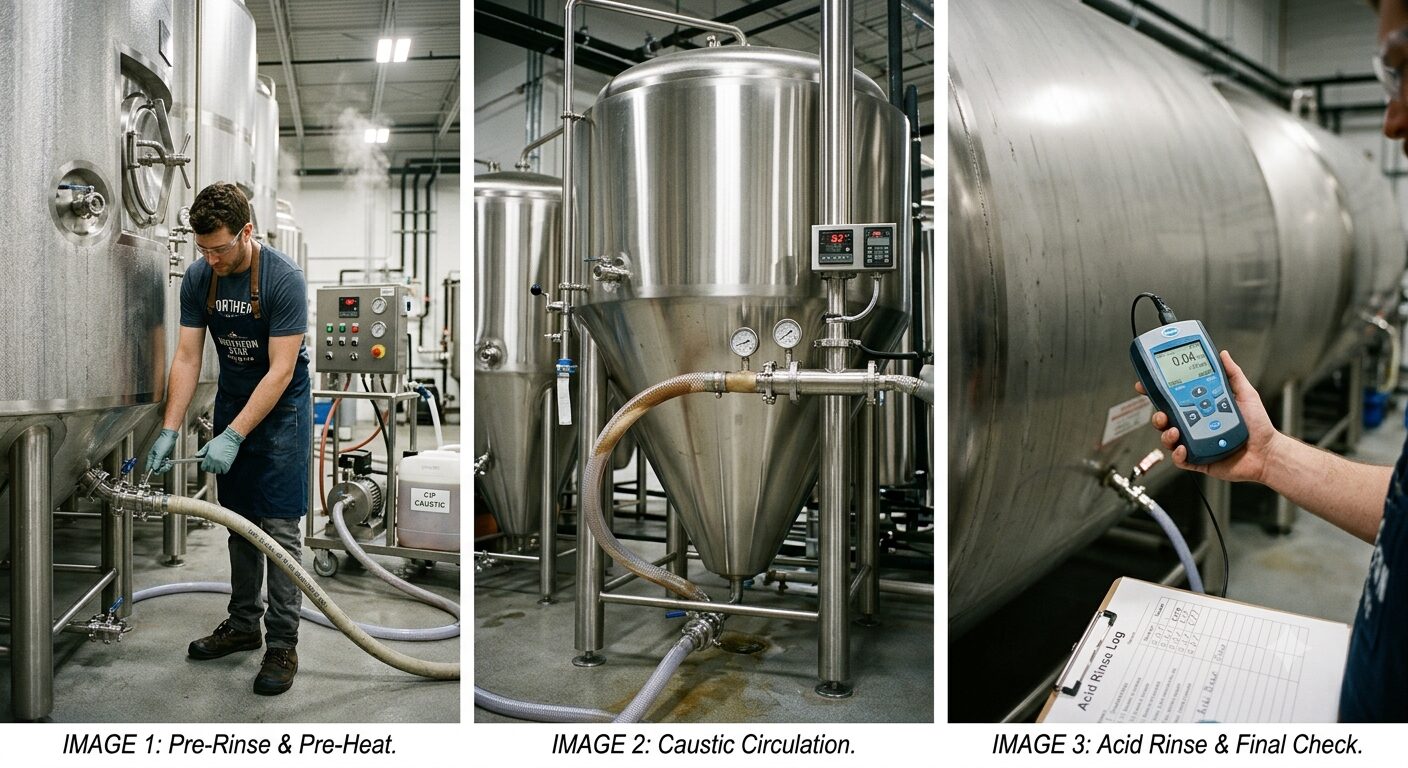
Good cleaning processes usually start with a pre rinse, which helps remove loose residue before the main cleaning cycle begins.
Then, specific cleaning solutions are circulated through tanks, pipes, and other internal surfaces to clean the interior surfaces more deeply.
This helps reduce contamination, remove buildup, and keep the brewing system safe, hygienic, and ready for the next batch.
Section 2: Mechanical Fluid Flow and the Scientific Elements of Loop Execution
To keep your beer quality high over long trips, you need a strong clean in place schedule across your floor.
The process works by circulating alkaline washes, hot water rinses, and acid sanitizers through sealed pipe paths.
The fast fluid flow creates a strong scrubbing action against the inside pipe walls, lifting stubborn films.
Before a fresh batch enters a tank, the system runs a multi-stage cleaning program to clear out yeast debris.
The fluid enters the vessel through fixed or rotating spray balls fitted to the top of the tank.
These spray heads throw a fast, even spray that runs down the inside walls to strip residues away.
The used chemicals drain into the bottom cone, then a return pump sends the liquid back to the control system.
To study spray ball hydraulics and fluid velocity design, engineers use data from the European Hygienic Engineering & Design Group (EHEDG).
Recovering Beer Before the Pre-Rinse
Starting CIP while a long pipe is still full of beer sends good product straight to wastewater.
Long transfer lines may still hold saleable beer or wort when production ends.
A pipeline pig can push most of this liquid to a recovery tank before water enters the circuit.
Removing the product first lowers the organic load the CIP system must handle.
This improves beer yield while cutting pre-rinse time, wastewater, and chemical use.
Pigging needs a compatible pipeline, safe launch and recovery points, and a clear split between recovered beer and cleaning liquids.
Section 3: Digital Management Frameworks and Electronic Parameter Regulation
Moving away from manual cleaning means fitting a modern automated CIP system on your cellar floor.
The core system uses high-pressure pumps, air-driven flow valves, steam heat exchangers, and digital sensors.
The main PLC panel watches temperature, pressure, and chemical strength in real time during the wash.
If pressure drops anywhere in the fluid path, the system stops the loop at once and sets off an alarm.
Automated software removes human error from daily cleaning, preventing accidents or ruined batches.
By letting the software control the flow rates, you can be sure your cleaning loops run as designed every day.
This precise control makes sure every tank and vessel leaves the floor fully clean and ready for fresh beer.
To study wild yeast biology and draft-line hygiene, managers read journals from the American Society of Brewing Chemists (ASBC).
Section 4: Operational Economics and Sanitation Efficiency Calculations
Deciding how to split your weekly cleaning hours between hand work and machines starts with hard numbers.
Running the numbers on a manual cleaning vs cip brewery setup helps directors plan for growth.
Hand spray-down methods need constant labor, waste huge amounts of water, and expose your crew to strong chemicals.
Hand scrubbing also cannot safely reach the high walls of large modern tanks.
A sealed automated loop uses far less chemical because it recirculates the solution over a set time.
By cutting tank turnaround from six hours to forty-five minutes, you can run more batches per week.
This big boost in tank use lets fast-growing brands scale up without buying more fermenters.
To review balance calculations and pressure charts, technicians study the guides from the Brewers Association.
Matching the Cycle to the Real Soil Load
More cleaning is not always better cleaning.
A brewery should not use its strongest cycle on every piece of equipment.
Beer is usually thinner than many foods and holds less fat, so some circuits clean with shorter times, less energy, or fewer chemical stages.
A lightly soiled bright tank does not need the harsh program used for a kettle with baked-on protein and hop residue.
Heated surfaces, dirty kettles, and dried protein deposits may still need a stronger program.
When validation confirms the result, matching the cycle to the real soil cuts cost without lowering hygiene.
Using Recovered Heat for CIP Water
The brewery may already make much of the heat it needs for cleaning.
Heat from wort cooling, boiler exhaust, refrigeration, or air compressors can be recovered to preheat CIP water.
A buffer tank can store the warm water until the next cleaning cycle starts.
This lowers the work needed from the steam exchanger or electric heating elements.
The system must keep product, wastewater, and clean water fully separated through a proper heat exchanger.
Instead of paying to remove heat in one place and make it again in another, the brewery uses the same energy twice.
Section 5: Structural Design Topologies of Industrial Process Piping Networks
The best design for your facility depends on your water costs, your space, and your batch volumes.
An advanced brewery cip system can be built as a single-use loop or a fully recirculating multi-tank setup.
Single-use designs pump fresh water and chemicals through the vessel once, then send the mix down the drain.
Single-use styles prevent cross-batch contamination, but they use huge amounts of water and raise chemical costs.
Recirculating multi-tank systems capture and store the rinse water and hot caustic for later runs.
This design needs a bigger upfront investment for tanks and valves, but it can cut daily utility costs by up to forty percent.
For facilities running several shifts a day, a recirculating design is the most sustainable, low-cost path.
Including Flexible Hoses in the CIP Program
A fixed steel line can be perfectly designed, yet one badly placed hose can still create a hygiene problem.
Flexible hoses should be treated as part of the process circuit, not as temporary extras.
Their inside width, length, condition, and position change the speed of the cleaning liquid.
A hose wider than the connected pipe can lower turbulence and get an incomplete wash.
Store hoses off the floor, let them drain, and check them for cracks, swelling, soft spots, and worn fittings.
Avoid temporary connections that create branches where beer or cleaning solution can sit trapped.
Designing a Self-Draining CIP Circuit
Stronger chemicals cannot make up forever for a pipe system that does not drain well.
Horizontal lines should slope toward the drain or return point.
Branches, valve bodies, instrument ports, sample points, and reducers should be placed so liquid does not stay trapped after the cycle.
Standing rinse water can dilute sanitizer, feed microbes, and spoil the next product transfer.
The hardest branch or local part should be included in the validation plan, not just the main return line.
Designing the circuit to drain by itself usually beats raising chemical strength or wash time again and again.
Section 6: Mobile Fluid Dynamics for Boutique Production Floors
For small brewpubs, labs, or startups, a large fixed cleaning skid may not fit the space or the budget.
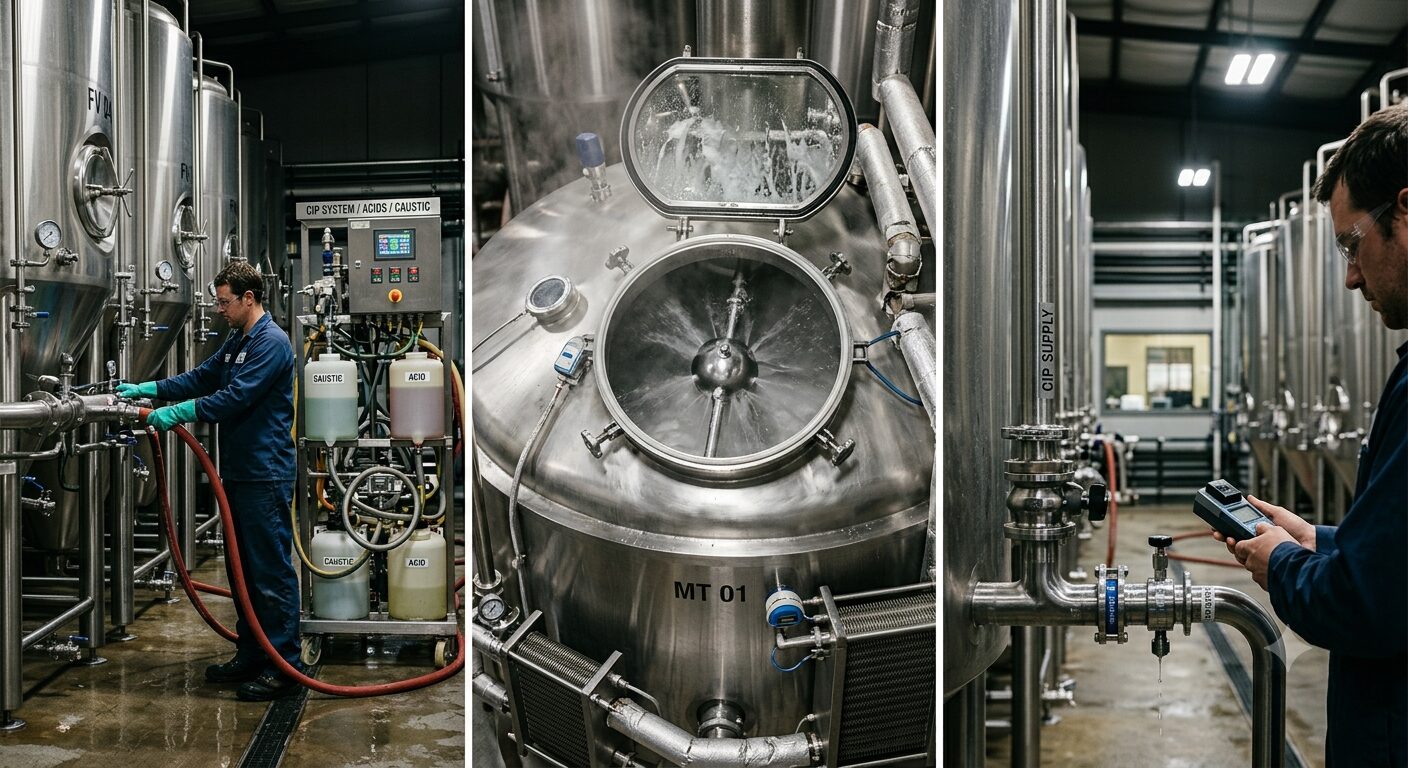
A flexible, mobile cip cart lets your crew roll cleaning power straight to any tank on the floor.
These carts have two compact steel tanks, a dedicated high-pressure supply pump, and built-in electric heating.
Your team can move the cart through tight tank rows and connect flexible hoses to close the cleaning loop.
This setup lets small companies automate tank washing without spending a fortune on fixed pipelines.
The built-in return pump keeps heavy chemicals flowing out of the tank base, so liquid does not pool during the wash.
With a heavy-duty mobile cart, small venues can reach industrial cleaning standards on a small budget.
Section 7: Chemical Thermodynamics and Active Formulation Selection
A truly clean inside surface needs the right brewery cip chemicals for each stage of the wash.
The main cleaning stage uses an alkaline compound, usually a strong caustic (sodium hydroxide) heated to about 140°F to 175°F.
This hot alkaline wash breaks down stubborn proteins, hop resins, and dead yeast stuck to the steel.
The second stage uses a phosphoric or nitric acid wash to dissolve minerals and beer stone.
The final stage uses a sanitizer, like peracetic acid, to kill any remaining microbes.
You must keep the chemical strengths and temperatures balanced to clean fully without damaging your lines.
To set safe wash temperatures and protect your staff, the Master Brewers Association of the Americas (MBAA) offers full cellar safety guides.
Cold Sanitizing vs Hot-Water Sanitizing
Hot-water sanitizing needs time and energy to bring the whole circuit up to temperature.
The vessel may also need to cool down before it can take the next batch.
An approved peracid sanitizer can work with cool water, cutting heating time and removing the cool-down rinse when the product allows no-rinse use.
Skipping the final water rinse can also lower the risk of adding microbes from the brewery water after sanitizing.
Always follow the sanitizer maker’s approved concentration, contact time, temperature, and rinsing steps.
Oxidizing Boosters for Tough Deposits
When staff still need to scrub a kettle by hand after CIP, the problem may be the chemistry, not the cycle length.
Some soils stay stuck even after a normal alkaline wash.
An approved oxidizing booster added to the caustic can help remove protein, light beer stone, and residue in heat exchangers or kettles.
Never improvise chemical mixes.
Materials like BUNA, EPDM, Viton, and PTFE do not all react the same way, so check pumps, hoses, spray devices, and seals first.
Prepare and use the approved mixture only as the supplier’s safety and dosing instructions say.
Controlling Foam and Hard-Water Minerals
A detergent that makes a big head of foam can make the CIP loop harder to control.
Foam can disturb the pump, cut liquid contact with the surface, cause overflow, and make return-flow readings less reliable.
Low-foaming surfactants help the solution wet and release organic soil while still suiting high-speed circulation.
Hard-water agents and chelating compounds can bind minerals that would otherwise weaken the detergent or build scale.
Choose the chemical program for both the brewery soil and the local water hardness.
Section 8: Quality Assurance and Microbiological Verification Protocols
To confirm your cleaning loops work, you need a strict cip cleaning validation routine.
You cannot just trust a visual check to confirm that a sealed steel pipe network is clean inside.
Modern programs use ATP bioluminescence swabs to detect trace organic material fast.
Teams collect samples from the final rinse and read them with a calibrated luminometer.
If the test shows a high light score, the system flags the loop as failed and forces a full re-wash.
Regular validation checks keep your cleaning routines hitting the strict standards needed for wholesale.
To balance high-tech validation with classic quality, teams read technical archives from the Siebel Institute of Technology.
Revalidating the CIP Process After Changes
A CIP recipe should not stay the same forever just because it worked when the system was new.
Review a validated program whenever you change a recipe, raw material, method, tank, valve, spray device, or chemical.
A cycle that suited the old process may not remove the new type or amount of soil.
Temperature probes, conductivity sensors, flow meters, switches, and alarms must be calibrated and checked regularly.
Good records let you confirm each cycle still matches the conditions used in the first validation.
Any important process or equipment change should trigger a documented revalidation before the new program becomes standard.
Section 9: Standard Operating Procedures and Preventative Maintenance Tracking
Building a top brand means organizing your daily floor work into a clear list of brewery cleaning procedures.
This master plan sets the exact chemical strengths, water volumes, and loop times for every vessel.
Bright tanks, wort chillers, yeast brinks, and fermenters all need wash profiles matched to their soil loads.
For example, a kettle needs a long, hot caustic wash for caramelized sugars, while a bright tank needs a low-temperature cycle to keep its gas pressure.
Your crew must log every wash cycle, noting temperature, chemical strength, and final validation scores in a database.
These strict records help directors find bottlenecks and trace any quality issue quickly.
To keep your layout safe and correctly piped, follow the frameworks from the Deutscher Brauer-Bund.

Section 10: Plant Scaling Milestones and Fixed Infrastructure Upgrades
As a brewery grows, moving from mobile carts to a permanent brewery cip skid becomes essential.
A fixed skid includes several large steel storage tanks, automatic chemical dosing pumps, and dedicated steam heating.
These heavy-duty systems run several cleaning loops at once across different parts of the plant.
This lets your team wash a large cellar tank while sanitizing your canning line in another room.
A permanent skid saves floor space, cuts chemical handling risks, and gives you full control over utility use.
By treating your cleaning skid as a core part of production, your brand can scale its wholesale volume smoothly.
To study line sanitation models and cleaning validation, teams check the archives of the Institute of Brewing & Distilling (IBD).
Section 11: System Infrastructure Performance Matrix
Choosing your core cleaning equipment means balancing upfront cost against daily labor hours.
The reference below shows what each equipment tier can do.
                           ┌──► Tanks: 2 x 50 gallon
[Mobile Two-Tank CIP Cart] ├──► Heating: internal electric immersion
                           └──► Best for: nano breweries and taprooms under 1,500 BBL/year
                                 ┌──► Tanks: 3 x 200 gallon
[Modular Multi-Tank Skid Layout] ├──► Heating: dedicated shell-and-tube steam exchanger
                                 └──► Best for: microbreweries and regional hubs up to 20,000 BBL/year
                                 ┌──► Tanks: 4+ x 1000 gallon
[Fully Automated Fixed Assembly] ├──► Heating: multi-zone steam loop with direct injection
                                 └──► Best for: industrial plants over 50,000 BBL/year
Section 12: Metallurgical Standards and Bio-Security Washing Cycles
The metal blend and inside finish of your tanks affect how long beer stays fresh and how much cleaning costs.
Commercial tanks should be made from strong stainless steel, usually AISI 304 or acid-resistant AISI 316L.
These steels have plenty of chromium and nickel, which form a self-healing protective layer on the surface.
This layer guards the tank against cleaning acids, hard water, and the natural acids in fruit and hops.
To stop bacteria, the inside steel must be polished very smooth, with a roughness of 0.8 micrometers or less.
Rough spots, welds, or scratches can hide wild yeast and shield it from a normal loop cycle.
With automatic cleaning hardware protecting your floor, your team can focus on making great, consistent beer.
Section 13: Facility Safety and Environmental Compliance Frameworks
Running an industrial cleaning system means balancing heavy chemical use with strict local laws.
The high-pH caustic washes and low-pH acid rinses cannot flow straight into the city sewer.
To meet water safety laws, modern plants must fit a dedicated wastewater neutralization system.
This system collects your spent cleaning loops in a holding tank and uses probes to balance the pH before discharge.
Your crew must also wear full protective gear, including chemical-resistant suits, heavy gloves, and face shields.
By making safety and the environment a priority, you protect your staff and keep the plant running without legal delays.
Preventing Vacuum Failure After Hot CIP
The biggest danger can appear after the hot wash seems finished.
A fast switch from a hot cycle to a cold-water rinse can create a vacuum inside a closed tank.
As the steam cools and condenses, the inside pressure drops in seconds.
If air cannot enter through a correctly sized vacuum-relief device, outside pressure can dent or collapse the vessel.
Fermenters and bright tanks should have proper vacuum protection, and the vent path must stay clean and open during the whole cycle.
The PLC should also block unsafe valve combinations and overly fast temperature changes.
Section 14: Final Summary and Operational Sanitation Blueprint
Choosing your core setup needs a clear view of your sales goals, your space, and your budget.
If you run a taproom where beer moves fast on-site, a compact mobile cart is an affordable start.
But if you want to grow wholesale across many states, a fully automated fixed skid is a must.
Check your building’s floor weight limits, balance your chemical strengths, and enforce strict validation loops.
Pick the right setup for your volume, treat your cleaning line as a key partner, and your team can keep delivering great beer.
Contact Us