
Read Time: ⏱️ 10 minutes | By: Luca
Manual Cleaning vs. CIP: The Choice
Keeping your tanks and lines clean is the job that protects every batch of beer.
As a brewery grows, cleaning by hand can become a real bottleneck.
When you go past a handful of small tanks, weighing a manual cleaning vs cip brewery setup becomes an important step.
Your brewhouse work only stays good if your cold-side cleaning keeps the beer safe until it reaches the glass.
So cellar managers must decide: keep spending labor hours on bucket-and-brush washing, or automate the cleaning loops.
Look at your weekly tank turnover, your tank sizes, and your water use to find the right point to automate.
This guide compares the two methods on cost, quality, safety, and equipment.
When Manual Cleaning Still Makes Sense
Manual cleaning can remain practical in very small breweries with a limited number of accessible vessels and short production runs.
It may also be suitable for removable parts, open equipment, and areas that can be inspected directly.
The initial cost is lower because the brewery does not need a dedicated skid, automated valves, sensors, or fixed return piping.
However, this option becomes less attractive as tank size, cleaning frequency, and production volume increase.
The decision should therefore be based on the total weekly cleaning workload rather than brewery size alone.
CIP is not automatically the best first investment for every new brewery.
A small operation with a few easy-to-reach tanks may still clean effectively with carefully controlled manual procedures.
The balance changes when employees spend more time washing equipment than producing beer.
At that point, automation begins to protect both production capacity and labor availability.
Combining Manual Cleaning, COP, Foam Cleaning, and CIP
A brewery sanitation program normally uses more than one cleaning method.
CIP is suitable for closed tanks, pipes, fillers, and circuits designed for circulation.
COP is used for removable valves, gaskets, short pipe sections, fittings, and other parts placed inside a dedicated parts washer.
Manual cleaning remains useful for accessible areas requiring direct inspection or localized mechanical action.
Foam cleaning is designed for external tank walls, equipment frames, floors, and other open surfaces that cannot be cleaned through the internal CIP circuit.
Each component should be assigned to the method that can reach and clean it most reliably.
The real choice is rarely manual cleaning or CIP for the entire brewery.
A tank interior may be cleaned automatically, while its removable fittings go into a parts washer and its outside surface receives a foam wash.
Some small areas may still need direct attention by hand.
A clear equipment map showing the correct method for every component prevents staff from assuming that the CIP cycle cleaned parts it never reached.
How a CIP Loop Works
A CIP loop cleans a tank without taking it apart.
It circulates an alkaline wash, hot-water rinses, and an acid sanitizer through the sealed clean in place path.
The fast fluid flow scrubs the inside walls and lifts stubborn films.
The liquid enters through spray balls mounted at the top of the tank.
These spray heads throw a high-speed pattern that cascades down the walls to strip residue away.
The used solution drains into the bottom cone, and a return pump sends it back to the control system.
For the engineering of spray-ball hydraulics, see the European Hygienic Engineering & Design Group.
Comparing Manual and Automated Final-Rinse Control
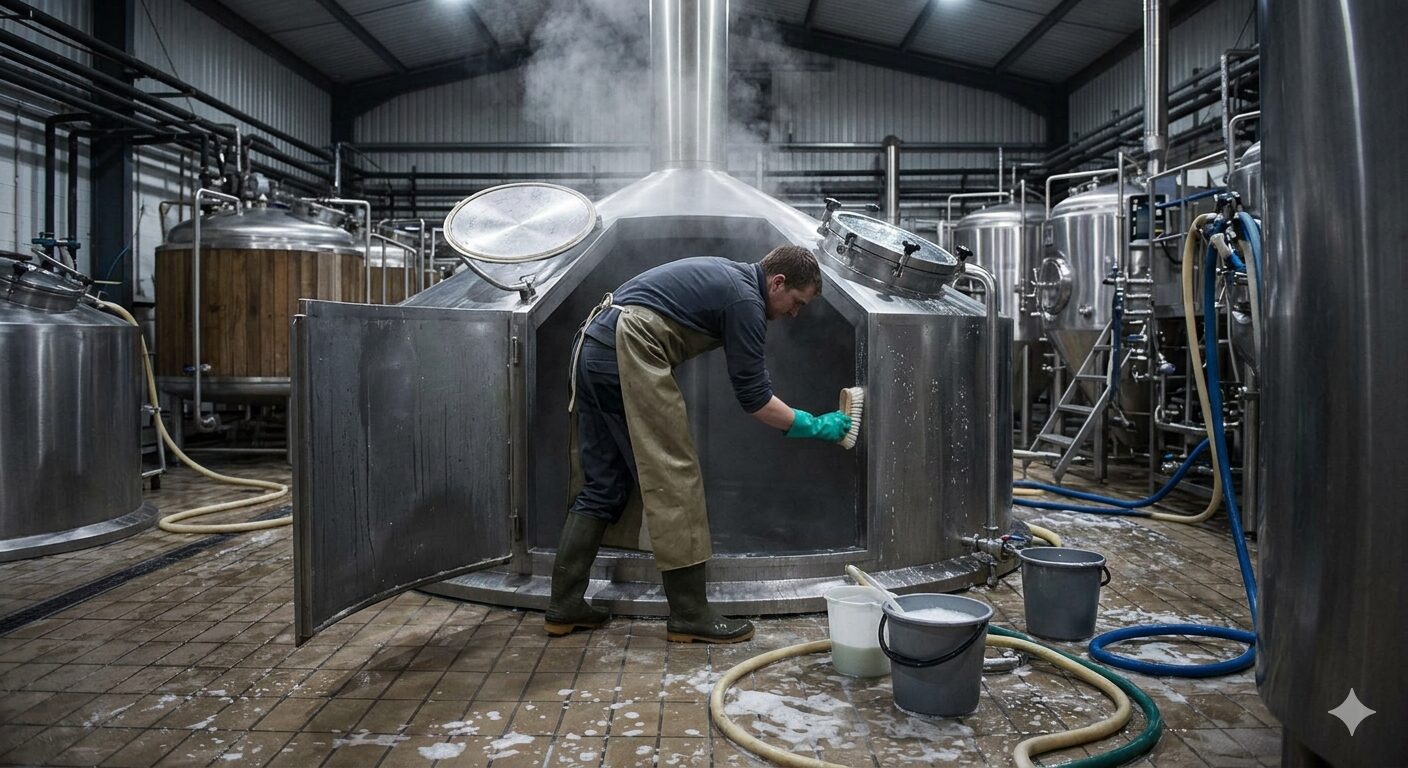
A manual cleaning program often ends the rinse according to elapsed time, visual appearance, smell, or operator judgment.
An automated CIP system can use conductivity or pH measurements to confirm that the returning liquid has approached the baseline value of the incoming water.
This reduces the risk of ending the rinse while alkaline or acid residue remains inside the circuit.
It can also prevent unnecessary water use after the chemical has already been removed.
Regardless of the cleaning method, the brewery should define a measurable final-rinse acceptance limit rather than relying only on clear-looking water.
Clear water can still contain cleaning chemical.
This makes the final rinse one of the clearest differences between a visual manual check and an instrument-controlled CIP cycle.
A conductivity or pH endpoint gives the team an objective answer.
The rinse ends when the measured result is acceptable, not simply when the operator believes enough time has passed.
Automated Control and Sensors
Moving away from manual cleaning means adding an automated CIP system to your cellar.
It uses high-pressure pumps, pneumatic valves, steam heat exchangers, and digital sensors.
The control panel watches temperature, pressure, and chemical strength in real time during the wash.
If pressure drops anywhere in the path, the system stops the loop and raises an alarm.
Automated control removes much of the human error from daily cleaning.
By trusting the software to control the flow, your cleaning loops run the same way every day.
For research on line hygiene, see the American Society of Brewing Chemists.
Planning for CIP System Downtime
Automation introduces a new operational risk: the brewery depends on pumps, valves, sensors, software, and control hardware being available.
A failed flow meter, damaged valve actuator, pump fault, or PLC problem can prevent a validated cleaning cycle from starting.
The brewery should maintain a written fallback procedure for critical equipment.
This may include a mobile CIP cart, a manual circulation pump, approved temporary hoses, spare sensors, and a list of components that can be cleaned out of place.
The fallback method must be validated before it is needed, not improvised during a production emergency.
A fully automated system saves time only while it is working.
When one essential component fails, the brewery still needs a safe way to clean the equipment and protect the production schedule.
Keeping a few critical spare parts and a tested backup procedure can prevent one sensor or valve from stopping the entire cellar.
The alternative process should produce a verified clean, not simply get the tank back into service quickly.
Keeping Out Infection
To protect your beer’s flavor over a long supply chain, you need tight biological control.
When wort travels across steel, it leaves organic soils that shield wild microorganisms.
If those soils are not fully dissolved during the wash, bacteria like Lactobacillus can take hold.
These infections cause off-flavors, cloudiness, and pressure spikes that can ruin a batch.
A circulating CIP brewing system drives cleaner deep into hard-to-reach spots like valve seats and pipe welds.
The fast flow lifts the films and sweeps them out to the drain.
For system-balance guidance, see the Brewers Association.
Single-Use vs. Recirculating Loops
The best layout depends on your water costs, your space, and your batch volumes.
A brewery cip system can be a single-use loop or a recirculating multi-tank setup.
Single-use designs pump fresh water and chemicals through once, then straight to the drain.
Single-use avoids cross-batch contamination, but it uses a lot of water and drives up chemical costs.
Recirculating systems store the intermediate rinses and caustic for future runs.
This costs more upfront for tanks and valves, but it can cut daily utility costs by a large amount.
For facilities running multiple shifts, a recirculating design is usually the more sustainable path.
Mobile CIP Carts for Small Floors
For small brewpubs, labs, or startups, a large fixed skid may not fit the space or budget.
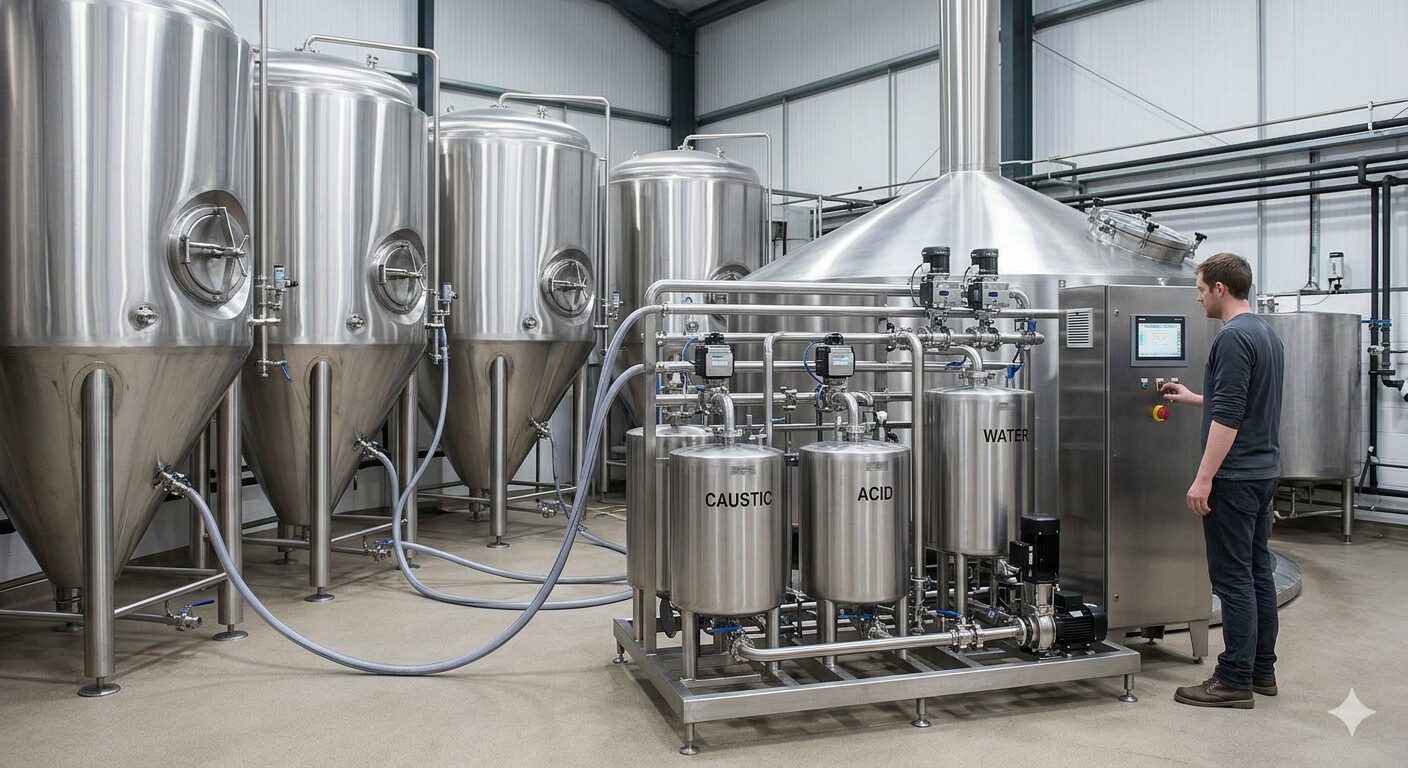
A mobile CIP cart lets your crew roll professional cleaning power to any tank.
These carts have two compact steel tanks, a supply pump, and built-in electric heating.
Your team can move the cart through tight tank rows and connect temporary hoses to make a closed loop.
This lets small breweries automate tank washing without paying for fixed pipelines.
The built-in return pump keeps the heavy solution flowing out of the tank base, so liquid does not pool during the wash.
The Cleaning Chemicals
A sterile inside surface needs the right brewery cip chemicals for each stage.
The first stage uses a hot caustic wash, usually a sodium hydroxide blend at about 140°F to 160°F.
This breaks down proteins, hop resins, and dead yeast clinging to the steel.
The second stage uses a phosphoric or nitric acid wash to dissolve mineral deposits and beer stone.
The final stage uses a sanitizer, like peracetic acid, to kill any remaining microorganisms.
Keep the chemical strength and temperature balanced to fully clean without damaging your lines.
For chemical-safety guides, see the Master Brewers Association of the Americas.
Verifying the Clean
A closed pipe network can look clean and still not be sterile inside, so you need to verify it.
Set up a CIP cleaning validation routine instead of trusting visual checks.
Modern programs use ATP swabs to detect trace organic material fast.
Take a sample from the final rinse and read it with a calibrated luminometer.
If the score is high, the system flags the loop as failed and forces a re-wash.
Regular checks keep your cleaning at the biological standard wholesale needs.
For quality resources, see the Siebel Institute.

Manual Touch-Up Can Hide a CIP Design Problem
Repeated manual touch-up after an automated cycle should be treated as a sign that the CIP process needs investigation.
The cause may be poor spray-head placement, insufficient pump capacity, incorrect line sizing, damaged nozzles, shadow areas, or a cleaning device that does not match the soil load.
Increasing chemical concentration or extending the cycle may temporarily improve the result without correcting the mechanical problem.
The brewery should record where manual cleaning is repeatedly required and use that information to improve the equipment or validated recipe.
If the same employee has to scrub the same part of the same tank after every CIP cycle, that work is not simply part of the routine.
It is evidence.
The spray pattern, flow, equipment condition, or cleaning recipe is probably failing in that location.
Fixing the cause is safer and less expensive than adding more chemical and accepting permanent manual touch-up.
Automation Does Not Eliminate Cleaning Management
A repeatable automated cycle still requires active supervision and maintenance.
The brewery must verify chemical strength, sensor calibration, valve movement, spray-device condition, flow delivery, return performance, and final-rinse results.
Operators should review cycle records instead of assuming that completion of the programmed sequence proves cleanliness.
Changes to recipes, equipment, soil load, or cleaning chemicals may also require the original program to be revalidated.
Automation improves consistency only when the system remains within the conditions used during validation.
The PLC can repeat the same instructions every day, but it cannot guarantee that a worn spray head or inaccurate sensor still produces the original result.
A completed cycle means that the program ran.
Verification shows whether the equipment was actually cleaned.
The brewery must therefore continue inspecting, testing, maintaining, and reviewing the process after automation is installed.
Cleaning Procedures and Records
A strong program organizes your daily duties into clear brewery cleaning procedures.
This plan lists the exact chemical strengths, water volumes, and loop times for every vessel.
Kettles, chillers, yeast brinks, and fermenters each need a wash profile matched to their soil load.
For example, a kettle needs a long hot caustic wash for caramelized sugars, while a bright tank needs a gentler cycle to protect its gas pressure.
Your crew should log every cycle: the temperature, the chemical strength, and the final validation score.
Good records help you find bottlenecks and trace any quality issue fast.
Layout and piping should also follow the frameworks managed by the Deutscher Brauer-Bund.
Training Staff After CIP Automation
Installing an automated CIP system changes the skills required from the cellar team.
Employees no longer control every cleaning step manually, but they must understand cleaning recipes, valve routes, alarms, chemical dosing, sensor readings, and emergency shutdown procedures.
Training should include normal operation, manual override limits, lockout procedures, chemical safety, and recognition of abnormal cycle data.
Only authorized employees should be able to change validated temperatures, concentrations, flow targets, or contact times.
Refresher training is also important when software, equipment, or cleaning recipes are updated.
Automation does not remove the need for skilled operators.
It changes their role.
Instead of carrying buckets and manually timing every wash, staff must understand what the control system is doing and recognize when the displayed values do not make sense.
Good training prevents employees from treating the CIP skid like a machine that can never make a mistake.
Controlling Manual Cleaning Tools
Manual cleaning tools can transfer soil and microorganisms between equipment when they are not separated and sanitized correctly.
Brushes, pads, hoses, and cloths should be assigned to specific production areas or cleaning stages.
A color-coding system can prevent a tool used on floors, drains, or dirty external surfaces from being used on product-contact equipment.
Reusable tools must be cleaned, inspected, dried, and stored away from the floor after use.
Damaged brushes and worn pads should be replaced because cracks and loose material can retain contamination or scratch stainless steel.
A clean-looking brush is not automatically a clean brush.
The same tool can carry residue from one vessel to another or bring drain contamination close to a product surface.
Assigning colors and storage locations to different tools makes mistakes less likely.
This is especially important in a manual program, where the cleaning result depends heavily on the habits of individual employees.
Scaling Up to a Fixed Skid
As you grow, moving from mobile carts to a permanent skid becomes essential.
A fixed skid has several large storage tanks, automated dosing pumps, and dedicated steam heating.
It can run several cleaning loops at once across different areas of the plant.
This lets you wash a big cellar tank while sanitizing your canning line in another room.
A permanent skid saves floor space, reduces chemical handling, and gives you full control of your utilities.
By treating your skid as a core part of production, your brand can scale its volume smoothly.
Including Maintenance and Support in the CIP Comparison
The financial comparison should include the maintenance required by the automated system.
Pumps, seals, valve actuators, spray devices, sensors, heat exchangers, and PLC components require inspection and eventual replacement.
Before purchasing a CIP system, the brewery should confirm spare-parts availability, technical-support response times, remote troubleshooting options, and the cost of planned service.
A system that saves labor but remains unavailable for several days after a small failure can create expensive production delays.
Critical spare parts should be selected according to supplier lead times and the operational importance of each component.
Automation replaces part of the daily manual workload with a new maintenance responsibility.
The brewery will need fewer people scrubbing tanks, but it will depend more heavily on pumps, valves, and controls.
The cheapest CIP skid may become the most expensive option when replacement parts are difficult to find or technical support is slow.
Maintenance cost and supplier support belong in the original comparison.
System Tiers Compared
Choosing your cleaning equipment means balancing upfront cost against daily labor.
Here are the common tiers.
First, a mobile two-tank CIP cart:
[Mobile Two-Tank CIP Cart]
   ├──► Tanks: two 50-gallon tanks
   ├──► Heating: internal electric elements
   └──► Best for: nano breweries and taprooms under 1,500 BBL a year
Next, a modular multi-tank skid:
[Modular Multi-Tank Skid]
   ├──► Tanks: three 200-gallon tanks
   ├──► Heating: a shell-and-tube steam exchanger
   └──► Best for: microbreweries and regional hubs up to 20,000 BBL a year
And a fully automated fixed assembly:
[Fully Automated Fixed Assembly]
   ├──► Tanks: four or more 1,000-gallon tanks
   ├──► Heating: a multi-zone steam loop with direct injection
   └──► Best for: industrial plants over 50,000 BBL a year
Tank Metal and Surface Finish
The alloy and inner finish of your tanks affect shelf life and daily cleaning costs.
Commercial tanks should be built from stainless steel, usually AISI 304 or acid-resistant AISI 316L.
These alloys have high chromium and nickel, which form a self-healing passive layer on the surface.
This layer protects the tank from cleaning acids, high-chloride water, and the natural acidity of fruit and hops.
To keep bacteria out, the inside steel must be polished very smooth.
Rough spots, weld lines, or scratches can shelter wild yeast from a standard cleaning loop.
Safety and Wastewater
Running an industrial cleaning system means balancing heavy chemicals with strict local laws.
The high-pH caustic and low-pH acid rinses cannot flow straight into the municipal sewer.
So modern facilities install a wastewater neutralization system.
It collects the spent cleaning solutions in a tank and uses probes to balance the pH before discharge.
Your crew must also wear full protective gear, including chemical-resistant suits, gloves, and face shields.
By making safety and compliance a priority, you protect your staff and avoid legal delays.
Manual Cleaning and Confined-Space Entry
Reaching through a manway can qualify as confined-space entry when any part of the employee’s body crosses the opening.
This means that manually touching up the underside of a manway or looking inside a vessel can require the same safety controls as entering the tank completely.
Where possible, inspections should be performed from outside with mirrors, lights, cameras, or fiber-optic equipment.
Portable cleaning heads and long-handled tools can also address missed areas without placing the employee inside the vessel.
When entry cannot be avoided, the brewery needs appropriate atmospheric testing, ventilation, training, permits, communication, and rescue planning.
Manual tank cleaning can become a confined-space task much sooner than employees expect.
Even placing a head and arm through the manway may expose the worker to concentrated carbon dioxide or low oxygen.
The safer response to a missed area is usually to improve the cleaning device or use a tool from outside.
Entering the vessel should be the last option and must follow a formal safety procedure.
Conclusion
Choosing your cleaning setup takes a clear view of your sales goals, space, and capital.
If you run a taproom where beer sells fast on-site, a compact mobile cart is an affordable path.
But if you plan to grow wholesale across states, a fully automated fixed skid is essential.
Check your floor weight limits, balance your chemicals, and enforce strict validation on every loop.
The honest answer is rarely all-manual or all-CIP; most breweries use CIP for tanks and lines, and manual or foam cleaning for the rest.
By matching your method to each part of the plant, your team can deliver clean, consistent beer.
Contact Us