
Read Time: ⏱️ 10 minutes | By: Luca
Section 1: Establishing the Baseline Checklist for Cellar Bio-Security
Running a commercial brewery means following strict cleaning and safety rules every day.
For years, breweries cleaned by taking apart long runs of stainless steel pipe by hand.
That old method created bottlenecks and added hundreds of labor hours to every schedule.
A clear, complete set of brewery cleaning procedures changes how a plant handles interior cleaning.
Instead of hand-scrubbing, automated systems circulate cleaning chemicals through sealed loops.
This plan spells out how often each tank and line must be cleaned to stay free of chemical or biological buildup.
Good cleaning takes a solid grasp of chemistry, flow, and the right concentrations.
Whether you run a taproom or an industrial plant, your chemical choices shape your operating costs.
This guide breaks down the returns, the engineering, and the chemicals behind alkaline, acid, and sanitizing washes.
What a Brewery Cleaning SOP Should Include
A cleaning standard operating procedure (SOP) puts your routine in writing.
A good SOP lists the exact steps, chemical strengths, temperatures, contact times, and safety gear for each vessel.
It says who cleans what, how often, and how to record that it was done.
Clear SOPs mean any trained worker can clean correctly, even on a new shift.
Written procedures also make training, audits, and troubleshooting far easier.
Color-Coded Cleaning Tools
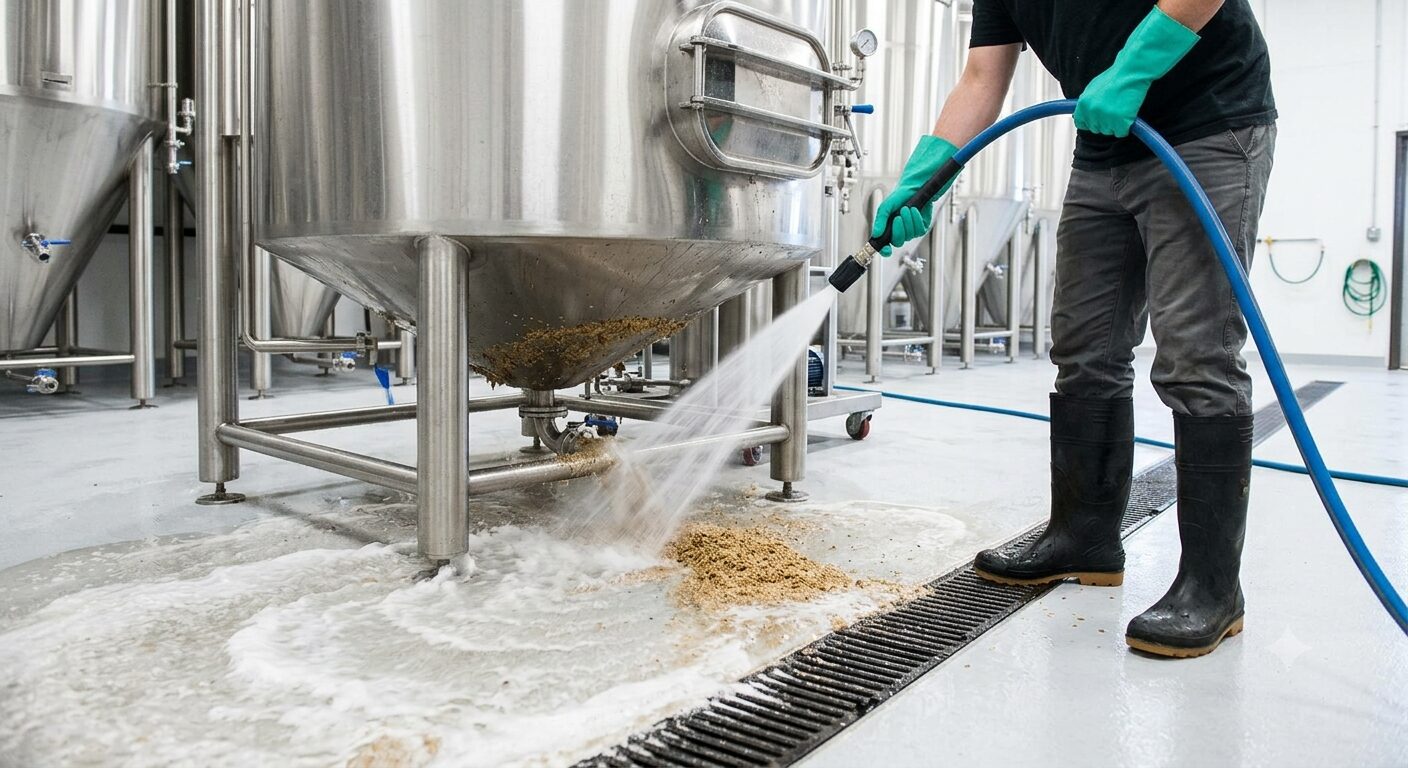
Color-coding your cleaning tools prevents cross-contamination.
Brushes, buckets, and squeegees each get a color for a specific zone, like the cellar, the floor, or the packaging area.
This keeps a tool that touched a floor drain from ever touching a food-contact surface.
Staff learn the colors quickly, so mistakes drop even during busy shifts.
A simple color system is a cheap, effective way to keep cleaning zones separate.
Section 2: Mechanical Automation and Chemical Loop Dynamics
Moving away from manual cleaning means deploying a modern automated CIP system on your cellar floor.
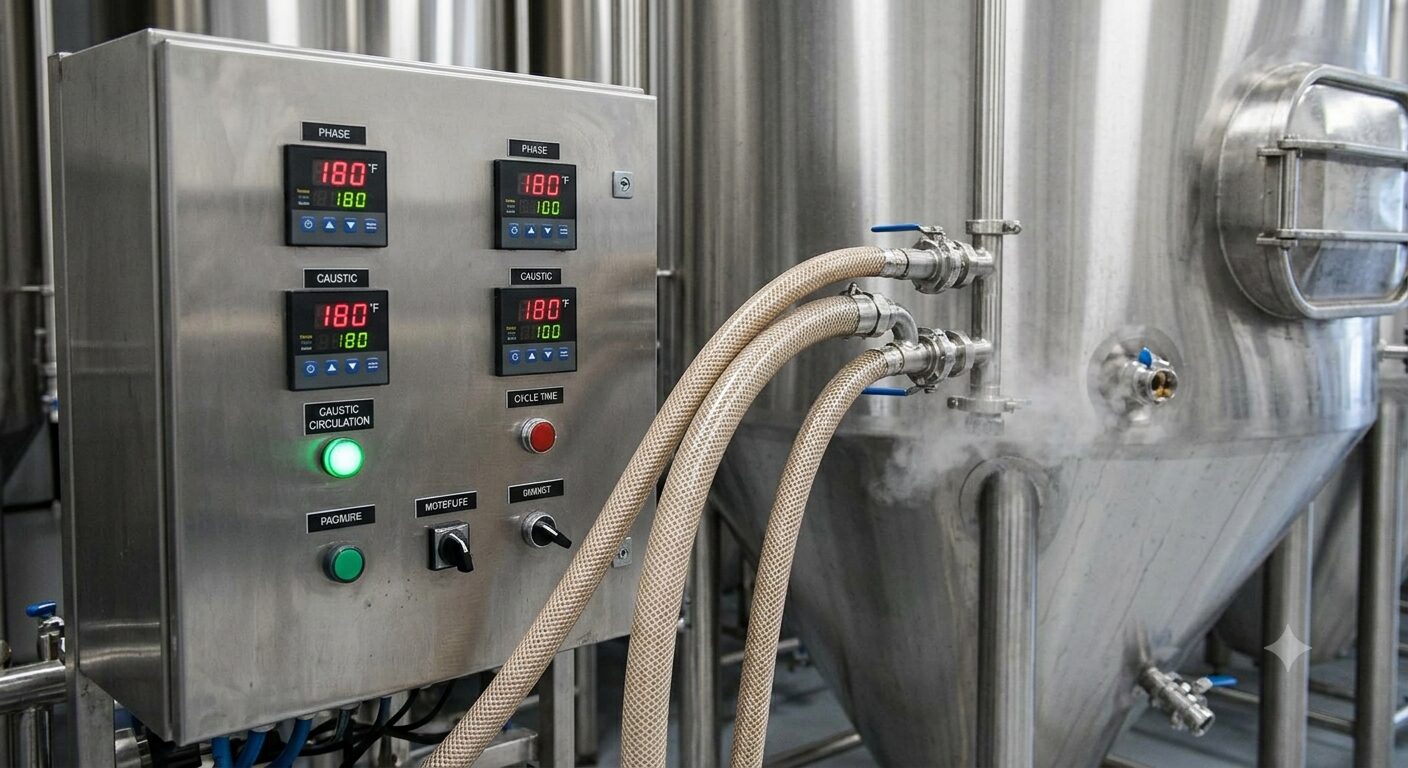
The core system uses high-pressure pumps, pneumatic valves, steam heat exchangers, and digital sensors run by a central PLC panel.
The PLC doses the cleaning chemicals into the wash stream based on real-time conductivity readings.
By trusting the software to control the flow and dosing, you make sure every loop runs exactly as designed.
Automation removes human error from daily cleaning, preventing accidents and ruined batches.
The controller watches flow meters and temperature sensors and adjusts the pumps to hold the right spray pattern.
If the chemical concentration drops anywhere, the system adjusts the dosing pumps to restore the balance.
To read about automated control and design standards, see the European Hygienic Engineering & Design Group (EHEDG).
Section 3: Microbiological Quality and the Science of Process Loop Sanitation
To protect your beer’s flavor across long supply chains, you need tight biological control.
The cip brewing process works by combining strong mechanical flow with active cleaning chemicals.
When wort or juice moves across steel, it leaves organic soils that shelter microbes.
If those soils are not fully dissolved, bacteria like Lactobacillus can take hold.
These infections cause off-flavors, cloudiness, and pressure spikes that hurt your reputation.
An automated system drives cleaners deep into hard-to-reach spots like valve seats and welds.
The high-velocity flow shears the organic films off the walls and sweeps them to the drain.
To read about yeast and plant hygiene, see the journals from the American Society of Brewing Chemists (ASBC).
Section 4: Operational Economics and Sanitation Efficiency Calculations
To plan your weekly cleaning hours, it helps to compare the real costs of each method.
Running the numbers on a manual cleaning vs cip brewery setup helps directors plan for growth.
Manual scrubbing needs constant labor, wastes a lot of water, and exposes your crew to strong chemicals.
It also cannot safely clean the high walls of large modern tanks.
A sealed automated loop uses far less chemical because it recirculates the solution for a set time.
By cutting tank turnaround from six hours to about forty-five minutes, you can run more batches per week.
That jump in tank use lets a growing brand scale up without buying more fermentation tanks.
Section 5: Structural Topologies of Industrial Process Piping Networks
The best layout for your plant depends on your water cost, your space, and your batch volume.
A brewery cip system can be built as either a single-use loop or a recirculating multi-tank setup.
A single-use design pumps fresh water and chemicals through the tank once, then sends it to the drain.
It avoids cross-batch contamination, but it uses a lot of water and raises chemical costs.
A recirculating multi-tank system saves the rinse water and hot caustic for reuse on later runs.
This costs more upfront for tanks and valves, but it can cut daily utility costs by up to forty percent.
For a plant running several shifts a day, a recirculating design is the most cost-effective path.

Section 6: Mobile Fluid Dynamics for Boutique Production Floors
For small brewpubs, labs, or startups, a big fixed cleaning skid may not fit the space or budget.
A flexible, mobile cip cart lets your crew roll professional cleaning power to any tank on the floor.
These carts have two compact stainless steel tanks, a supply pump, and electric heating elements.
Your team can move the cart through tight tank rows and connect hoses to make a closed cleaning loop.
This lets a small brewery automate tank washing without a fortune in fixed pipework.
A built-in return pump keeps the solution flowing out of the tank base, so it does not pool.
With a heavy-duty mobile cart, a small venue gets industrial-grade cleaning on a small budget.
Section 7: Fluid Dynamics and Kinetic Energy in Clean-In-Place Circuits
Keeping your beer clean means controlling the flow of cleaning fluid inside the tanks and lines.
Oxygen and biological soils are the enemies of packaged beer, causing contamination that destroys aromas.
To protect the flavor, a good setup uses a sealed process called clean in place inside the tanks and pipes.
Instead of taking equipment apart, the system locks onto the process lines and runs a multi-stage program.
It pushes cleaning solution through the lines at the right pressure and velocity to scrub the interior tank walls.
The balanced flow reaches every surface, so the whole vessel gets cleaned without manual scrubbing.
To read about line balance and pressure charts, see the guides from the Brewers Association.
Section 8: Quality Assurance and Microbiological Verification Protocols
To confirm your cleaning works, you need a strict cip cleaning validation routine.
You cannot just trust a visual check to know a closed steel pipe is clean inside.
Modern validation uses ATP bioluminescence swabs to detect trace organic material instantly.
Teams take a sample from the final rinse and read it with a digital luminometer.
If the reading is too high, the system flags the loop as failed and forces a re-wash.
Regular checks make sure your cleaning consistently hits the standards needed for distribution.
To balance automated checks with quality, see the archives of the Siebel Institute of Technology.
Cleaning Sign-Off and Equipment Release
A tank should not go back into use until someone signs off that it is clean.
A sign-off step means a named person checks and approves the cleaning before the tank is released.
This adds accountability and creates a record of who cleared each vessel.
A simple tag or digital log shows a tank’s status at a glance: dirty, cleaning, or clean and released.
Sign-off and release control stops a dirty or half-cleaned tank from being filled by mistake.
Section 9: Chemical Thermodynamics and Active Formulation Selection
A truly clean surface needs the right brewery cip chemicals for each stage of the wash.
The main cleaning phase uses a hot caustic (sodium hydroxide), usually heated to around 140°F to 160°F.
This hot caustic breaks down proteins, hop resins, and dead yeast stuck to the steel.
The next stage uses a phosphoric or nitric acid wash to dissolve minerals and beer stone.
The final phase uses a sanitizer, like peracetic acid, to kill any remaining microbes.
Keeping the chemical strength and temperature balanced cleans fully without damaging the steel.
In beer brewing, good cleaning and sanitation protect the quality of the beer and keep the production area safe.
A caustic cleaner, often based on caustic soda, is a common alkaline cleaner used to remove yeast, sugars, and beer buildup from tanks, pipes, and filling systems.
With the right contact time, temperature, and concentration, this solution supports effective cleaning and makes cleaning the cleaning equipment faster, safer, and more reliable before the next batch.
To read about safe wash temperatures and staff safety, the Master Brewers Association of the Americas (MBAA) has full cellar safety guides.
Labeling and Cleaning Secondary Chemical Containers
Any container you pour cleaning chemicals into must be clearly labeled.
When caustic or acid is moved from a drum into a smaller bucket or spray bottle, that secondary container needs a clear label.
The label should name the chemical and its hazards, so no one mistakes it for water or another product.
Secondary containers should also be cleaned and checked, because leftover chemical can react or cause harm.
Clear labeling and clean containers prevent dangerous mix-ups on the floor.
Section 10: Plant Scaling Milestones and Fixed Infrastructure Upgrades
As a brewery grows, moving from mobile carts to a permanent brewery cip skid becomes essential.
A fixed skid has several large stainless steel tanks, dosing pumps, and dedicated steam heating.
These systems run several cleaning loops at once across different areas of the plant.
You can wash a big cellar tank while sanitizing your canning line in another room.
A permanent skid saves floor space, lowers chemical-handling risk, and gives full control of your utilities.
Treating the skid as a core part of your production engine lets your brand scale smoothly.
To study sanitation and validation methods, see the archives of the Institute of Brewing & Distilling (IBD).
Preventive Maintenance for the Cleaning System
The cleaning system itself needs regular maintenance.
Pumps, valves, spray heads, sensors, and gaskets all wear out and must be checked and serviced.
A preventive maintenance schedule replaces worn parts before they fail mid-cycle.
Skipping this can leave you with a broken washer on a busy brew day and a tank that cannot be cleaned.
Keeping the cleaning system maintained protects every clean it performs.
Section 11: System Infrastructure Performance Matrix
Choosing your core cleaning gear means balancing upfront cost against daily labor.
The table below shows the capabilities of different equipment tiers:
| System Engineering Tier | Tank Count & Capacity | Primary Heating Integration | Target Facility Output |
| Mobile Two-Tank CIP Cart | 2 x 50 Gallon Tanks | Internal Electric Immersion Elements | Nano Breweries & Taprooms under 1,500 BBL/Year |
| Modular Multi-Tank Skid Layout | 3 x 200 Gallon Tanks | Dedicated Shell-and-Tube Steam Exchanger | Microbreweries & Regional Hubs up to 20,000 BBL/Year |
| Fully Automated Fixed Assembly | 4+ x 1000 Gallon Tanks | Multi-Zone Steam Loop with Direct Injection | Industrial Production Plants over 50,000 BBL/Year |
Section 12: Metallurgical Integrity and Fluid Mechanics
The alloy and surface finish of your tanks affect shelf life and cleaning costs.
Commercial tanks should be built from quality stainless steel, usually 304 or acid-resistant 316L.
These alloys hold chromium and nickel, which form a self-healing passive layer on the surface.
That layer protects the tank from cleaning acids, high-chloride water, and the acidity of fruit and hops.
To keep bacteria out, the inside steel should be polished very smooth.
Rough spots, weld lines, or scratches can shelter wild yeast from a standard sanitation wash.
For safe layout and piping standards, designs should follow the frameworks from the Deutscher Brauer-Bund.
Gasket Inspection and Spare-Part Management
Gaskets and seals are small parts that cause big problems when they fail.
Worn gaskets in valves, doors, and fittings can leak, hide soil, and let in contamination.
Inspect gaskets regularly and replace them at the first sign of cracking or hardening.
Keep a stock of common spare gaskets and seals so a failure does not stop production.
Good gasket care keeps your seals tight and your cleaning effective.
Section 13: Facility Safety and Environmental Compliance Frameworks
Running an industrial cleaning system means handling strong chemicals under strict local laws.
The high-pH caustic and low-pH acid used on the floor cannot go straight into the city sewer.
To follow water safety laws, modern plants install a wastewater neutralization system.
It collects the spent cleaning solutions in a tank and uses probes to balance the pH before discharge.
Your floor crew must also wear full protective gear: chemical suits, heavy gloves, and face shields.
By putting safety and compliance first, you protect your staff and avoid legal delays.
Confined-Space and Carbon Dioxide Safety
Cleaning inside tanks and cellars carries serious safety risks.
A tank is a confined space, and entering one to clean it can be deadly without the right training and gear.
Cellars can also build up carbon dioxide, which displaces oxygen and can cause a worker to pass out.
Never send an untrained worker into a vessel, and always test the air and use monitors and ventilation.
Confined-space and gas safety rules protect your team from the most dangerous cleaning tasks.
Waste Removal and Pest Prevention
Good cleaning includes removing waste and keeping pests out.
Spent grain, trub, and other waste must be removed quickly, because it attracts flies, rodents, and mold.
Leftover organic waste near tanks and drains becomes a source of infection for your beer.
Regular waste removal, sealed bins, and pest control keep the whole facility cleaner.
A clean, pest-free plant protects both your beer and your food-safety standing.
Keeping Solid Waste Out of Brewery Drains
Solid waste should never go down the drain.
Grain, hops, and trub clog drains and pipes and overload the wastewater system.
Use drain screens and catch trays to keep solids out, and dispose of them separately.
Blocked drains cause backups, bad smells, and a breeding ground for bacteria.
Keeping solids out of the drains protects your plumbing and your hygiene.
Controlling Employee Entry into Production Areas
Not everyone should walk freely into production and cleaning areas.
Controlling who enters keeps out contamination carried on shoes, clothes, and hands.
Use clear zones, handwashing stations, and boot washes at the entry to clean areas.
Limiting entry during cleaning also keeps people away from chemicals and wet floors.
Simple entry control protects both hygiene and staff safety.
Section 14: Final Summary and Operational Sanitation Blueprint
Choosing your setup takes a clear view of your sales goals, floor space, and budget.
If you run a taproom where beer sells fast on-site, a compact mobile cart is an affordable path.
If you plan to expand wholesale across several states, a fully automated fixed skid is essential.
Check your building’s floor weight limits, balance your chemical strengths, and enforce strict validation loops.
By matching the gear to your volume and treating your cleaning system as a key partner, your team can deliver excellent beer to the market.
Contact Us