
Read Time: ⏱️ 10 minutes | By: Luca
Section 1: Engineering Foundations of Commercial Cellar Architecture
Running a modern brewery well starts with smart, automated cleaning.
For a growing brewery, cleaning and filling steel tanks by hand quickly becomes a bottleneck.
When you design or upgrade a production floor, the build of your brewery cip system sets your daily utility bills and turnaround times.
Every recipe made in the brewhouse depends on your cold-side cleaning to keep its flavor until it reaches the glass.
Cellar managers must choose between two main designs: a single-use fluid network or a multi-tank recirculating system.
Looking at your water costs, chemical safety, and weekly batch counts will show the best choice for your layout.
Whether you supply a small taproom or run high-speed packaging lines, your cleaning choices set your daily labor cost.
This guide breaks down the fluid mechanics, layouts, and economics of a modern cleaning system.
In the brewing industry, good cleaning processes are essential to keep equipment safe, hygienic, and ready for production.
Each cleaning cycle should use the right cleaning solution to remove beer residue, yeast, sugars, and other buildup from tanks, pipes, and filling systems.
Different cleaning methods can be used depending on the equipment, but the goal is always the same: protect beer quality and reduce the risk of contamination.
Section 2: Fluid Dynamics and Kinetic Energy in Clean-In-Place Circuits
Keeping your beer quality high over long trips means controlling liquid speed during the cleaning loop.
Oxygen and biological soils are the main enemies of raw packaged beer, causing contamination that destroys aromas.
To protect your flavor, a strong industrial layout uses a sealed process called clean in place inside the pipes.
Before any liquid enters the tank, the machine locks onto the process lines and runs a multi-stage cleaning program.
The cycle clears out the room air and replaces it with clean, pressurized gas.
The system then matches the fluid pressure at the spray ball to the speed needed to scrub the tank walls well.
With the pressure balanced, the liquid flows smoothly down the tank wall, so it does not splash or lose control.
To study how flavor oxidation works in steel tanks, managers read resources from the Brewers Association.
Static Spray Balls, Rotary Spray Heads and Rotary Jets
The spray device inside the tank has a big effect on the whole CIP cycle.
Static spray balls clean mainly by wetting the surface and letting the solution flow down the walls.
They are simple and reliable but may need more water, chemicals, and time.
Rotary spray heads use spinning fans of liquid to improve coverage and reach spots a static pattern can miss.
Rotary jet heads give stronger mechanical impact through focused jets, which help remove heavy yeast rings and stubborn residue from large fermenters.
Choose the device by tank diameter, internal parts, soil level, available pressure, and pump flow.
Section 3: Digital Management Frameworks and Electronic Parameter Regulation
Moving away from manual cleaning means fitting a modern automated CIP system on your cellar floor.
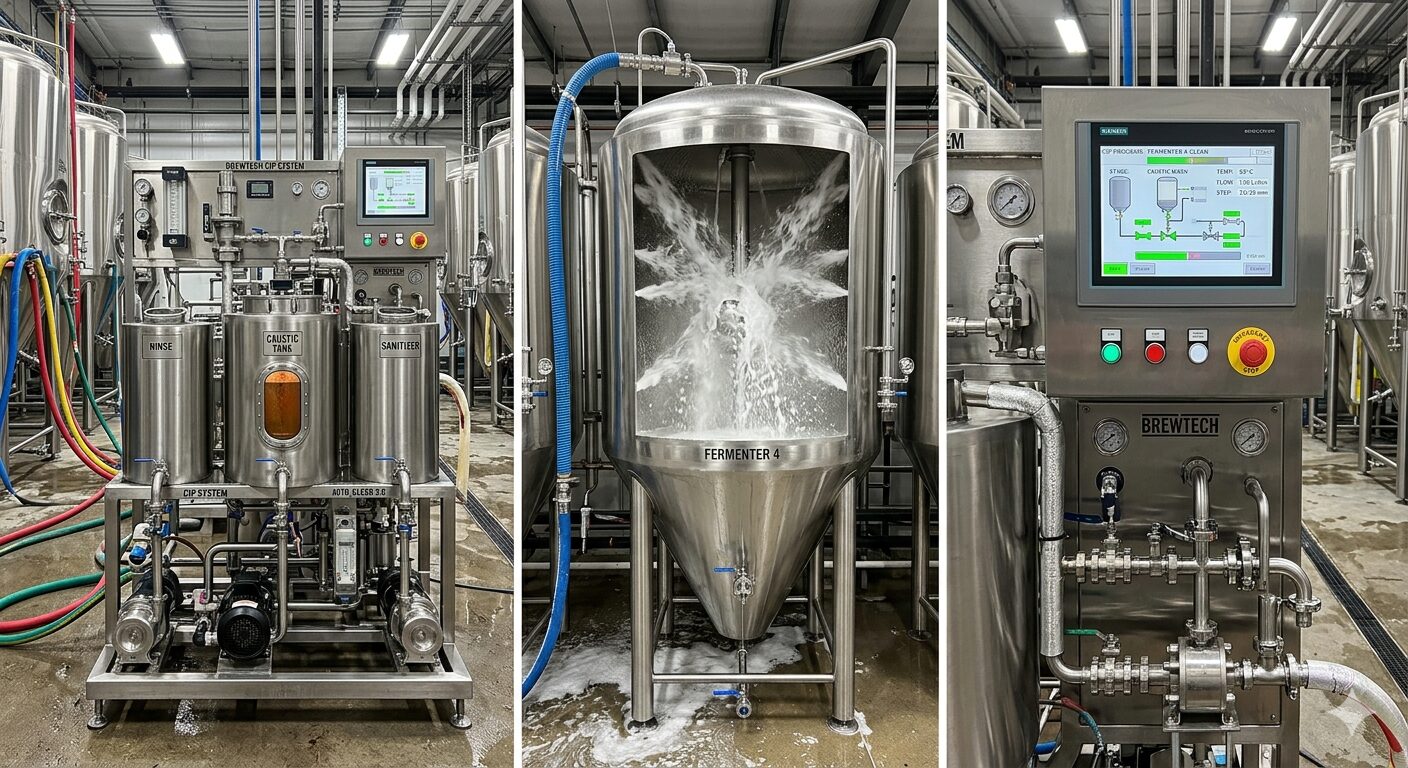
The core system uses high-pressure pumps, air-driven flow valves, steam heat exchangers, and digital sensors.
The main PLC panel watches temperature, pressure, and chemical strength in real time during the wash.
If pressure drops anywhere in the fluid path, the system stops the loop at once and sets off an alarm.
Automated software removes human error from daily cleaning, preventing accidents or ruined batches.
By letting the software control the flow rates, you can be sure your cleaning loops run as designed every day.
This precise control makes sure every tank and vessel leaves the floor fully clean and ready for fresh beer.
To study wild yeast biology and draft-line hygiene, managers read journals from the American Society of Brewing Chemists (ASBC).
Section 4: Microbiological Quality and the Science of Process Loop Sanitation
To protect your beer’s flavor over long supply chains, you must keep full biological control.
The process of modern cip brewing works by combining strong mechanical force with strong chemical cleaners.
When hot wort or fruit juice runs across steel sheets, it leaves organic soils that shield microbes.
If these soils are not fully dissolved during your wash, bacteria like Lactobacillus quickly take hold.
These infections cause bad off-flavors, cloudy beer, and sudden bottle pressure spikes that can ruin your name.
An automated loop drives cleaners deep into hard-to-reach spots, like valve seats and pipe welds.
The fast fluid flow creates a strong scrubbing action on the pipe walls, lifting films and sweeping them to the drain.
To review wash-line schematics and design rules, engineers use the European Hygienic Engineering & Design Group (EHEDG).
CIP Requirements for Unfiltered and Unpasteurized Beer
An unfiltered or unpasteurized beer depends heavily on good cellar hygiene.
Cleaning matters even more when the beer is not pasteurized or microfiltered.
These beers get no final step to lower the microbe load before packaging.
Plate heat exchangers, fermenters, transfer lines, and fillers all need carefully validated cleaning and sanitizing cycles.
Fruit beers, sour beers, and recipes with extra organic ingredients may need different programs, because they leave more complex residue.
With no final pasteurization to fix a problem, these sensitive areas must get consistent, verified CIP cycles.
CIP, Sanitizing and Sterilization-in-Place
A clean tank is not always sanitized, and a sanitized tank is not always sterile.
Cleaning, sanitizing, and sterilizing are three different steps.
CIP removes organic residue, minerals, and other soils from the equipment.
Sanitizing lowers microbes to a safe level using chemicals or hot water.
Sterilization-in-Place, or SIP, uses a stronger treatment, often saturated steam, for a higher level of microbe kill.
Standard brewery CIP gear is not automatically ready for SIP.
Before using steam, confirm that tanks, valves, seals, instruments, and piping can handle the required temperature and pressure.
Section 5: Analyzing Manual Scrub Protocols vs Automated Configurations
Deciding how to spend your weekly cleaning hours starts with hard financial data.
Running the numbers on a manual cleaning vs cip brewery setup helps directors plan for growth.
Hand spray-down methods need constant labor, waste huge amounts of water, and expose your crew to strong chemicals.
Hand scrubbing also cannot safely reach the high walls of large modern tanks.
A sealed automated loop uses far less chemical because it recirculates the solution over a set time.
By cutting tank turnaround from six hours to forty-five minutes, you can run more batches per week.
This big boost in tank use lets fast-growing brands scale up without buying more fermenters.
Chemical and Rinse Water Recovery
Instead of sending every cleaning solution to the drain, a recovery system lets you use it again.
A recovery-type CIP can collect caustic and acid after each cycle and return them to a storage tank.
The chemicals can be reused while their strength, temperature, and cleanliness stay within limits.
Some systems also recover water from the middle rinse.
That water can become the pre-rinse for the next cycle, cutting water use and wastewater.
This saves water and chemicals without lowering cleaning quality.
Section 6: Mobile Fluid Dynamics for Boutique Production Floors
For small brewpubs, labs, or startups, a large fixed cleaning skid may not fit the space or the budget.
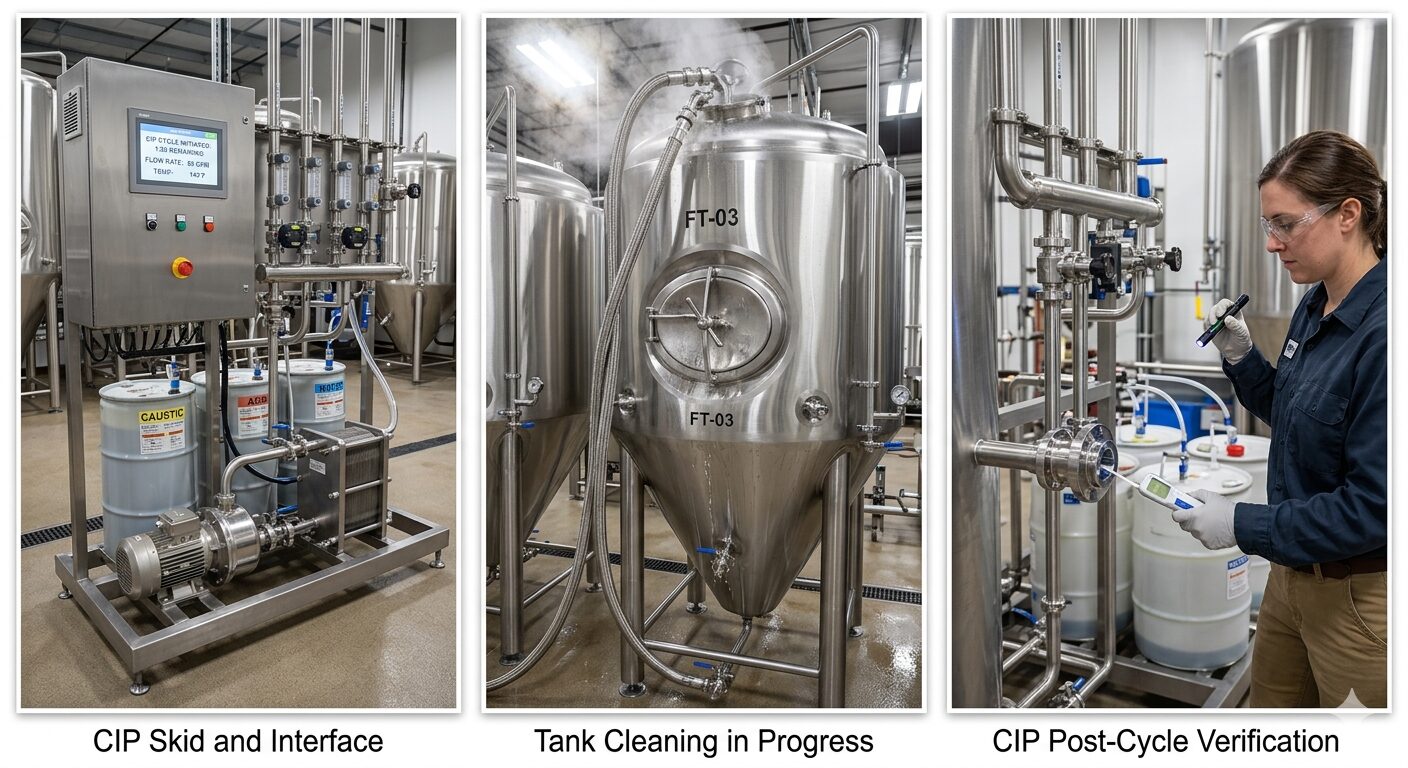
A flexible, mobile cip cart lets your crew roll cleaning power straight to any tank on the floor.
These carts have two compact steel tanks, a dedicated high-pressure supply pump, and built-in electric heating.
Your team can move the cart through tight tank rows and connect flexible hoses to close the cleaning loop.
This setup lets small companies automate tank washing without spending a fortune on fixed pipelines.
The built-in return pump keeps heavy chemicals flowing out of the tank base, so liquid does not pool during the wash.
With a heavy-duty mobile cart, small venues can reach industrial cleaning standards on a small budget.
Section 7: Chemical Thermodynamics and Active Formulation Selection
A truly clean inside surface needs the right brewery cip chemicals for each stage of the wash.
The main cleaning stage uses an alkaline compound, usually a strong caustic (sodium hydroxide) heated to about 140°F to 175°F.
This hot alkaline wash breaks down stubborn proteins, hop resins, and dead yeast stuck to the steel.
The second stage uses a phosphoric or nitric acid wash to dissolve minerals and beer stone.
The final stage uses a sanitizer, like peracetic acid, to kill any remaining microbes.
You must keep the chemical strengths and temperatures balanced to clean fully without damaging your lines.
To set safe wash temperatures and protect your staff, the Master Brewers Association of the Americas (MBAA) offers full cellar safety guides.
Why the Intermediate Rinse Is Important
The rinse between the caustic and acid stages does more than remove visible residue.
It also stops leftover caustic from neutralizing the acid cleaner.
If too much caustic stays in the circuit, the acid loses part of its power before it reaches beer stone and minerals.
Moving straight from caustic to acid wastes chemicals and gives a weaker result.
The middle rinse should run until the return water reaches the required pH or conductivity.
This keeps the two stages separate and lets the acid work properly on beer stone and mineral scale.
Surfactants and Chelating Agents
Caustic soda does not always have to work alone.
Surfactants and chelating agents can improve a caustic cleaner.
Surfactants help the solution spread across the steel and get into greasy or organic deposits.
Chelating agents bind minerals like calcium and magnesium, helping control beer stone and hard-water deposits.
This is especially useful in breweries with hard water or tanks that build minerals quickly.
Choose the formula by your water chemistry, soil load, and equipment; a strong alkaline mix can sometimes reduce the need for separate acid cycles.
Section 8: Quality Assurance and Microbiological Verification Protocols
To confirm your cleaning loops work, you need a strict cip cleaning validation routine.
You cannot just trust a visual check to confirm that a sealed steel pipe network is clean inside.
Modern programs use ATP bioluminescence swabs to detect trace organic material fast.
Teams collect samples from the final rinse and read them with a calibrated luminometer.
If the test shows a high light score, the system flags the loop as failed and forces a full re-wash.
Regular validation checks keep your cleaning routines hitting the strict standards needed for wholesale.
To balance high-tech validation with classic quality, teams read technical archives from the Siebel Institute of Technology.
Manual Verification and CIP Troubleshooting
Automation makes CIP more reliable, but the operator should not trust the screen blindly.
Automatic dosing and conductivity sensors should be backed up by regular manual checks.
An operator can take a sample from the CIP tank and use a titration kit to confirm the real caustic or acid strength.
This helps catch sensor drift, dosing faults, or chemicals that have become too weak after repeated use.
When a tank is still dirty after the cycle, check the spray head, temperature, chemical strength, liquid level, and pump.
Low liquid levels or air in the circuit can cause pump cavitation and cut the flow needed for good cleaning.

Section 9: Standard Operating Procedures and Plant Floor Calendars
Building a top brand means organizing your daily floor work into a clear list of brewery cleaning procedures.
This master plan sets the exact chemical strengths, water volumes, and loop times for every vessel.
Bright tanks, wort chillers, yeast brinks, and fermenters all need wash profiles matched to their soil loads.
For example, a kettle needs a long, hot caustic wash for caramelized sugars, while a bright tank needs a low-temperature cycle to keep its gas pressure.
Your crew must log every wash cycle, noting temperature, chemical strength, and final validation scores in a database.
These strict records help directors find bottlenecks and trace any quality issue quickly.
To keep your layout safe and correctly piped, designs should follow the frameworks managed by the Deutscher Brauer-Bund.
How Often Should a Brewery Run a CIP Cycle?
There is no single CIP calendar that works for every brewery.
The right cleaning frequency depends on the equipment, schedule, beer style, and how much residue it makes.
Fermenters, bright tanks, transfer lines, and packaging gear are usually cleaned after each batch or product change.
Equipment that sits empty for a while may need a short sanitizing cycle before it goes back into production.
A fermenter with a heavily hopped beer may need a different cycle from a bright tank that held a filtered lager.
Set a separate cleaning schedule for each tank, line, and machine based on how it is used and how dirty it gets.
When Clean-Out-of-Place Is Still Necessary
CIP is very effective, but it cannot do everything.
A CIP system cannot always reach every part of the equipment.
Gaskets, small fittings, sample valves, manway areas, and removable parts can create shadows where the solution does not give enough contact.
These parts should be removed and cleaned with a Clean-Out-of-Place (COP) process.
COP usually means soaking the parts in a cleaning solution, then rinsing, inspecting, and sanitizing them before reassembly.
Combining CIP with a simple COP routine helps the brewery avoid hidden contamination points an automated loop may miss.
Section 10: Plant Scaling Milestones and Fixed Infrastructure Upgrades
As a brewery grows, moving from mobile carts to a permanent brewery cip skid becomes essential.
A fixed skid includes several large steel storage tanks, automatic chemical dosing pumps, and dedicated steam heating.
These heavy-duty systems run several cleaning loops at once across different parts of the plant.
This lets your team wash a large cellar tank while sanitizing your canning line in another room.
A permanent skid saves floor space, cuts chemical handling risks, and gives you full control over utility use.
By treating your cleaning skid as a core part of production, your brand can scale its wholesale volume smoothly.
To study line sanitation models and cleaning validation, teams check the archives of the Institute of Brewing & Distilling (IBD).
Adapting the CIP System to the Building
A CIP skid may have the right capacity on paper and still not fit the building.
Design the CIP station around the available space, not just the tank capacity.
Ceiling height, access doors, maintenance space, floor drains, pipe routes, and the distance to the equipment all shape the final design.
When headroom is tight, makers may change the tank shape or use lower, wider storage vessels.
Leave enough clearance around pumps, valves, heat exchangers, and instruments for inspection and maintenance.
Checking these details before ordering lets the maker adapt the tank shape and skid layout to your real floor.
Section 11: System Infrastructure Performance Matrix
Choosing your core cleaning equipment means balancing upfront cost against daily labor hours.
The reference below shows what each equipment tier can do.
                           ┌──► Tanks: 2 x 50 gallon
[Mobile Two-Tank CIP Cart] ├──► Heating: internal electric immersion
                           └──► Best for: nano breweries and taprooms under 1,500 BBL/year
                                 ┌──► Tanks: 3 x 200 gallon
[Modular Multi-Tank Skid Layout] ├──► Heating: dedicated shell-and-tube steam exchanger
                                 └──► Best for: microbreweries and regional hubs up to 20,000 BBL/year
                                 ┌──► Tanks: 4+ x 1000 gallon
[Fully Automated Fixed Assembly] ├──► Heating: multi-zone steam loop with direct injection
                                 └──► Best for: industrial plants over 50,000 BBL/year
Section 12: Metallurgical Standards and Bio-Security Washing Cycles
The metal blend and inside finish of your tanks affect how long beer stays fresh and how much cleaning costs.
Commercial tanks should be made from strong stainless steel, usually AISI 304 or acid-resistant AISI 316L.
These steels have plenty of chromium and nickel, which form a self-healing protective layer on the surface.
This layer guards the tank against cleaning acids, hard water, and the natural acids in fruit and hops.
To stop bacteria, the inside steel must be polished very smooth, with a roughness of 0.8 micrometers or less.
Rough spots, welds, or scratches can hide wild yeast and shield it from a normal loop cycle.
For advice on gas safety and line-balance math, engineers use data from the National Restaurant Association.
Section 13: Facility Safety and Environmental Compliance Frameworks
Running an industrial cleaning system means balancing heavy chemical use with strict local laws.
The high-pH caustic washes and low-pH acid rinses cannot flow straight into the city sewer.
To meet water safety laws, modern plants must fit a dedicated wastewater neutralization system.
This system collects your spent cleaning loops in a holding tank and uses probes to balance the pH before discharge.
Your crew must also wear full protective gear, including chemical-resistant suits, heavy gloves, and face shields.
By making safety and the environment a priority, you protect your staff and keep the plant running without legal delays.
Section 14: Final Summary and Operational Sanitation Blueprint
Choosing your core setup needs a clear view of your sales goals, your space, and your budget.
If you run a taproom where beer moves fast on-site, a compact mobile cart is an affordable start.
But if you want to grow wholesale across many states, a fully automated fixed skid is a must.
Check your building’s floor weight limits, balance your chemical strengths, and enforce strict validation loops.
Pick the right setup for your volume, treat your cleaning line as a key partner, and your team can keep delivering great beer.
Contact Us