
Read Time: ⏱️ 10 minutes | By: Luca
Section 1: Mobile Cleaning for Small Breweries
Running a brewery means taking cleaning and hygiene seriously.
For a growing brewery, cleaning and filling steel tanks by hand quickly becomes a bottleneck.
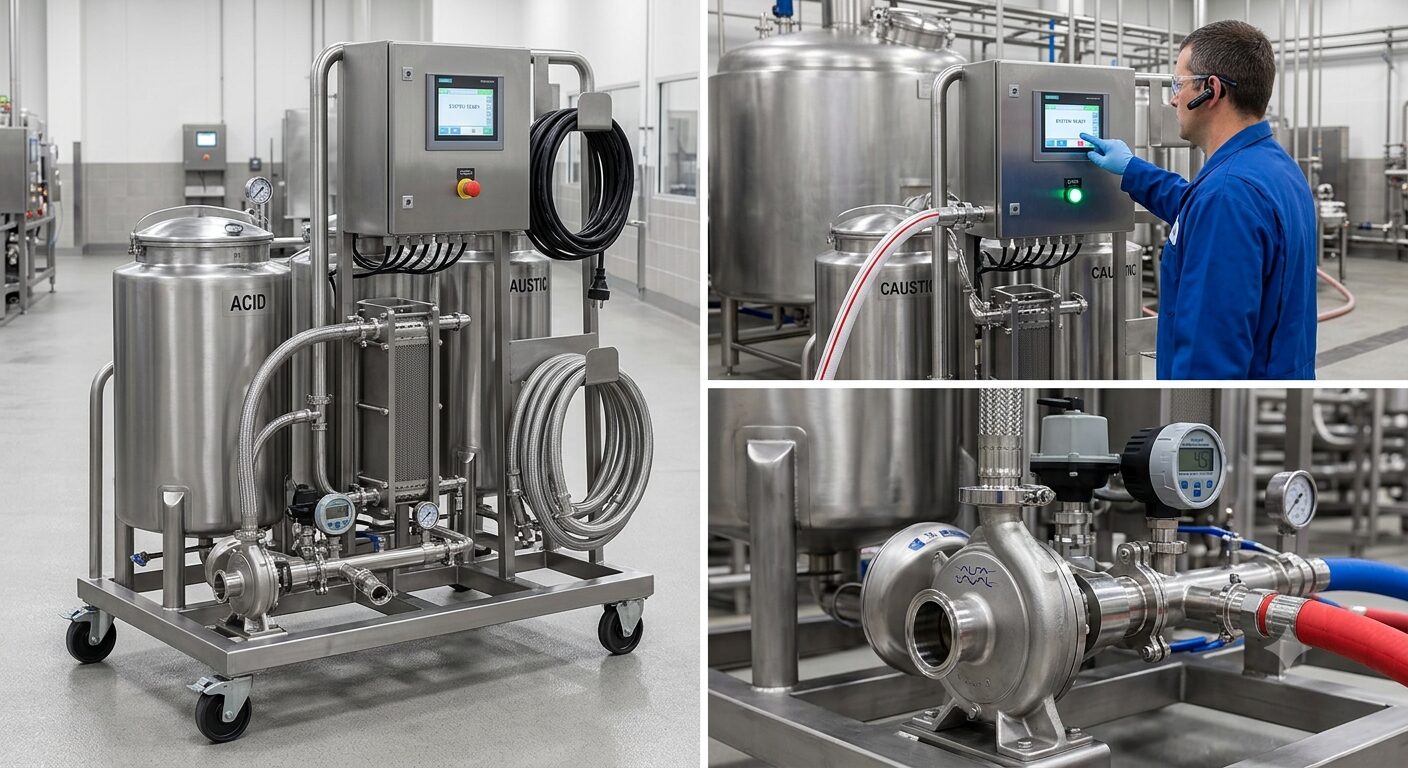
For a flexible craft cellar, a mobile cip cart lets your crew roll professional cleaning power right to any tank on the floor.
Every batch from the brewhouse depends on your cleaning choices to keep the beer fresh until it reaches the glass.
Managers have to decide whether to invest in fixed stainless pipe networks or keep cleaning by hand.
Looking at your weekly tank turnover, tank sizes, and aisle space shows the best choice for your layout.
Whether you supply a small taproom or run fast packaging lines, your cleaning setup shapes your daily labor.
This guide breaks down the fluid mechanics, layouts, and costs of a CIP cart.
In breweries, good cleaning processes keep tanks, pipes, and filling equipment safe and ready for production.
A clean in place CIP cart makes this easier, because it can circulate water, detergent, and sanitizer through the system without taking the equipment apart.
This saves time, cuts manual cleaning, and protects the beer’s quality from one batch to the next.
Pump Cart or Complete Mobile CIP Skid
Not every mobile cleaning unit is the same.
A simple pump cart is just a pump and hoses that push cleaning solution through a tank, using your own chemicals and buckets.
A complete mobile CIP skid adds its own tanks, heating, and controls, so it mixes, heats, and recirculates the solutions on board.
The pump cart is cheaper and lighter; the mobile skid is closer to a full automated system on wheels.
For a very small brewery, a pump cart may be enough to start.
As you grow, a mobile skid gives better control of temperature, dosing, and cycle time.
Matching the cart type to your needs avoids paying for features you will not use, or outgrowing it too soon.
Planning Utility Connections Around the Brewery
A mobile cart only helps if it can reach power, water, and drainage at each tank.
Before buying, map where you will use the cart and check for nearby power outlets, water supply, and floor drains.
The cart needs the right voltage and enough amperage for its pump and heater, plus a safe hose run to a drain.
Planning these connection points keeps the cart truly mobile instead of stuck near one outlet.
It is easy to buy a cart and then find it cannot reach half the tanks.
A quick utility map of the cellar shows where you may need extra outlets or drain points.
Good planning lets the cart move freely and clean every vessel without long, unsafe hose runs.
Section 2: Flow and Oxygen Protection in CIP
Good cleaning depends on the right liquid velocity through the loop.
Biological soils are the enemy of your beer, so the loop must scrub every surface.
To protect flavor, the system uses a sealed clean in place process inside the pipelines.
It locks onto the process lines and runs a multi-stage program.
It clears the air, then drives the cleaner at the right velocity to scrub the tank walls, with no splashing.
For flow-balance and pressure charts, see the Brewers Association.
Maintaining Temperature During Recirculation
For a caustic wash to work, the solution must stay hot the whole time it circulates.
As the caustic is recaptured in the CIP tank and pumped around again, it slowly loses heat to the tank, pipes, and air.
The cart needs a heater strong enough to hold the target temperature during the full cycle, not just at the start.
A wash that starts hot but cools partway through cleans much less effectively.
Cleaning power drops fast as the caustic cools.
A heater that keeps the loop at temperature the whole cycle protects the result.
On a mobile cart, sizing the heating element to the tank volume is key to a steady, hot wash.
Preventing Vortices and Pump Cavitation
The return pump must draw solution smoothly, or it can cavitate and lose flow.
When liquid drains toward the pump, a spinning vortex can form and pull air into the line.
Air in the pump causes cavitation: noisy running, lost flow, and long-term damage to the pump.
Good tank and outlet design, plus keeping enough liquid in the tank, prevents the vortex from starting.
A cavitating pump cannot keep the loop at full scrubbing force.
Simple steps, like an anti-vortex outlet and a minimum liquid level, keep the draw smooth.
Protecting the pump keeps the whole cleaning cycle stable and extends the cart’s life.
Section 3: Digital Control and Monitoring
Moving away from manual cleaning means using a modern automated CIP system approach.
The core system uses high-pressure pumps, pneumatic valves, steam heat exchangers, and digital sensors.
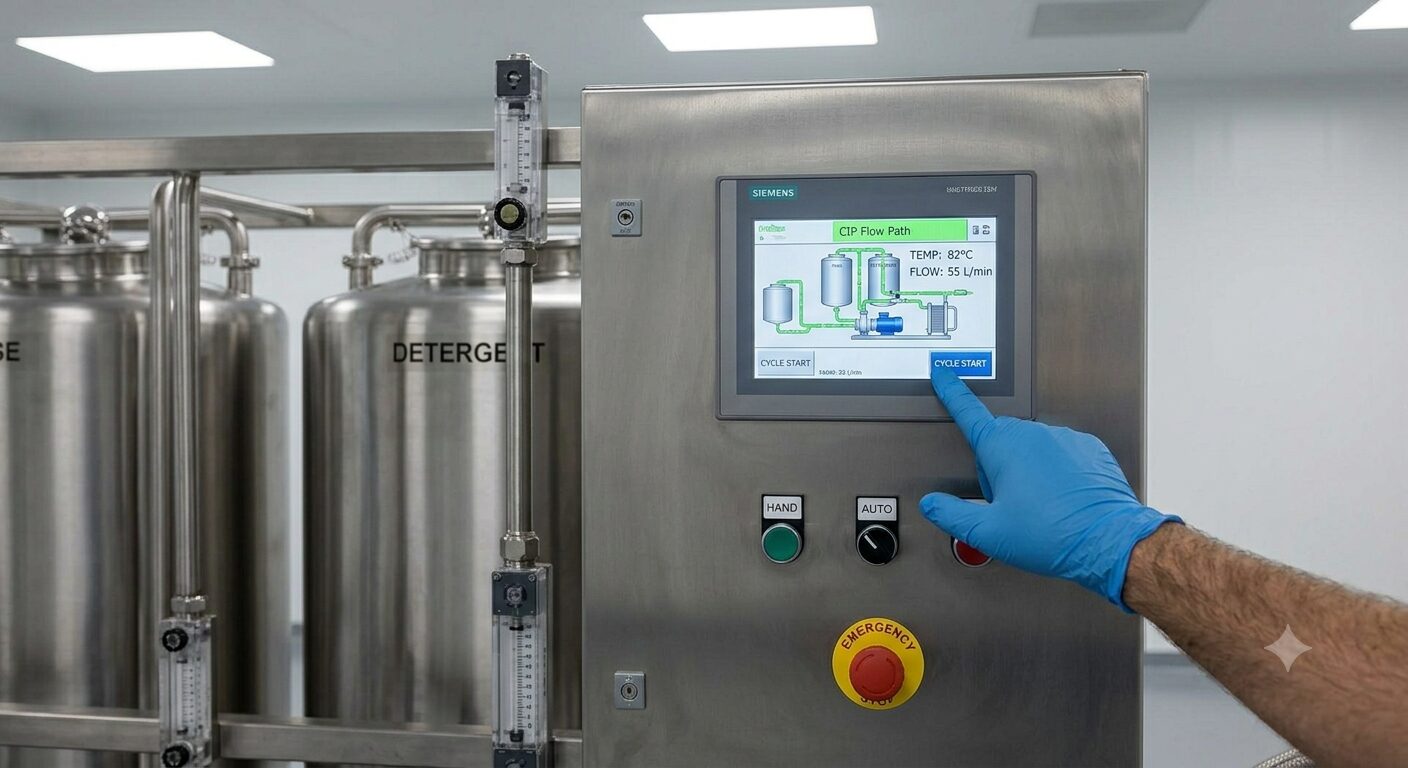
The PLC panel watches temperature, pressure, and chemical conductivity in real time during the wash.
If pressure drops anywhere in the loop, the system halts the cycle and raises an alarm.
Automated control removes human error, preventing accidents and ruined batches.
For the biology behind wild yeast and hygiene, see the American Society of Brewing Chemists (ASBC).
Flow Meters and Return-Line Monitoring
Flow meters on the cart confirm the cleaner is actually moving through the loop.
A supply-side flow meter shows the cart is pushing solution at the right rate.
A return-line check confirms the same amount is coming back, which means the loop is complete and not blocked or leaking.
If the return flow drops, it points to a blockage, a stuck spray ball, or a bad connection.
Pressure alone does not prove the liquid is circulating properly.
Watching both supply and return flow tells you the loop is truly closed and working.
This simple monitoring catches problems before a whole tank is left uncleaned.
Remote Control and Consumption Records
Advanced carts can be controlled remotely and can record what they use.
Remote control lets an operator start, watch, and adjust a cycle from a panel or screen instead of standing over the cart.
Consumption records log how much water, chemical, and energy each cycle uses, and whether it hit its targets.
This builds a history for quality checks and helps spot waste or drifting settings.
Remote operation keeps staff away from hot, chemical-heavy cycles.
The records turn each wash into data instead of a memory.
Over time, this shows which tanks cost the most to clean and where to save.
Section 4: The Science of CIP Cleaning
To protect your beer’s flavor over long supply chains, you need strong biological control.
Modern cip brewing works by combining fast fluid movement with strong chemical cleaners.
When hot wort or juice runs across steel, it leaves organic soils that shelter microbes.
If those soils are not dissolved during the wash, bacteria like Lactobacillus take hold.
These infections cause off-flavors, cloudiness, and pressure spikes that hurt your reputation.
An automated loop drives cleaners deep into hard-to-reach spots like valve seats and welds.
The high-speed flow shears the pipe walls, lifting the films and sweeping them to the drain.
For wash-line design standards, see the European Hygienic Engineering & Design Group (EHEDG).
Section 5: CIP vs Manual Cleaning
Deciding how to split cleaning between manual work and automated loops means looking at the numbers.
Running a real comparison of manual cleaning vs cip brewery helps directors plan growth.
Manual spray-down needs constant labor, wastes water, and exposes your crew to chemicals.
It also cannot safely reach the high walls of large tanks.
A sealed automated loop uses far less chemical because it recirculates the solution over time.
By cutting tank turnaround from six hours to forty-five minutes, you fit more batches into each week.
That jump in equipment use lets growing brands scale up without buying more tanks.
Section 6: The Parts of a CIP System
A high-efficiency cleaning setup combines several sub-systems into one workflow.
A professional brewery cip system is more than the pump and hoses.
It uses chemical dosing pumps, steam boilers or heaters, and controls.
The PLC panel watches temperature and pressure in real time and adjusts flow to prevent foaming.
If a tank shows an odd pressure reading, the software flags it and stops the loop.
This keeps dirty or damaged vessels out of the process, protecting the batch.
For control layouts and quality profiles, see the Siebel Institute of Technology.
Dedicated Tanks for Different Cleaning Solutions
A good CIP cart or skid keeps its cleaning solutions in separate tanks.
One tank holds caustic, another holds acid or sanitizer, and rinse water stays separate too.
Keeping them apart prevents the chemicals from mixing, which can neutralize them or create dangerous reactions.
It also lets the system recover and reuse each solution without contaminating the others.
Mixing caustic and acid by accident wastes both and can be hazardous.
Dedicated tanks make each stage of the wash clean and repeatable.
On a two-tank cart, this is why the cart is built to keep the solutions strictly separated.
Section 7: Cleaning Chemistry and Cycle Stages
A truly sterile surface needs the right brewery cip chemicals for each stage of the wash.
The main cleaning stage uses a hot caustic (sodium hydroxide) blend to break down proteins, hop resins, and dead yeast.
The second stage uses a phosphoric or nitric acid wash to dissolve mineral deposits and beer stone.
The final stage uses a sanitizer, such as peracetic acid, to kill any remaining microbes.
Keeping the chemical strengths and temperatures balanced cleans fully without damaging the metal.
For safe wash temperatures and staff safety, the Master Brewers Association of the Americas (MBAA) has full cellar guides.
Adjusting the Cycle to the Soil Level
Not every tank needs the same cleaning cycle.
A lightly soiled bright tank needs a shorter, cooler cycle than a kettle caked with caramelized sugar.
Matching the cycle time, temperature, and chemical strength to the real soil level saves chemical, water, and energy.
A cart with adjustable settings lets the operator dial the cycle to each vessel.
Running the heaviest cycle on every tank wastes resources.
Running a light cycle on a dirty kettle leaves soil behind.
Adjusting the cycle to the soil gives a clean result at the lowest cost.
Automatic Chemical Make-Up
Advanced systems can dose and mix their cleaning chemicals automatically.
Automatic make-up measures the concentrated chemical and water to hit the exact target strength, often using a conductivity sensor.
This keeps every wash at the right concentration without an operator measuring by hand.
It reduces both weak washes that fail and strong washes that waste chemical and stress the metal.
Hand-mixing chemicals is slow and easy to get wrong.
Automatic dosing keeps the strength consistent batch after batch.
It also keeps staff away from handling concentrated chemicals directly.

Section 8: Quality Assurance and Validation
To confirm your loops actually work, set up a strict cip cleaning validation routine.
You cannot just look at a sealed steel pipe and trust it is sterile inside.
Modern validation uses ATP bioluminescence swabs to detect trace organic material instantly.
The team samples the final rinse and reads it on a digital luminometer.
If the reading is high, the system flags the loop as failed and forces a re-wash.
Regular validation keeps your cleaning at the standard needed for wholesale.
Section 9: Standard Operating Procedures
A world-class brewery organizes its cleaning into a clear set of brewery cleaning procedures.
This plan lists the exact chemical strengths, water volumes, and loop times for every vessel.
Bright tanks, wort chillers, yeast brinks, and fermenters each need their own wash profile.
A kettle needs a long, hot caustic wash, while a bright tank needs a low-temperature cycle to keep its gas pressure.
Your crew should log every cycle: temperature, concentration, and validation score.
Good records help find bottlenecks and trace any quality issue fast.
Pre-Operation Inspection
Before each cleaning run, the operator should inspect the cart and connections.
Check the hoses for cracks, confirm the couplers are tight, and make sure the spray ball and valves are clear.
Verify the chemical levels, the heater, and that the drain path is open before starting.
A two-minute check prevents leaks, missed connections, and failed cycles.
A loose hose or a blocked spray ball can ruin a wash and create a chemical spill.
A quick pre-op check catches these before the pump starts.
Making the inspection a habit protects both the beer and the crew.
Section 10: Scaling Up to a Fixed CIP Skid
As you grow, upgrading from a mobile cart to a permanent brewery cip skid becomes essential.
A fixed skid has several large steel storage tanks, automated dosing pumps, and steam heating.
These systems run several cleaning loops at once across the plant.
You can wash a big cellar tank while sanitizing the canning line in another room.
A fixed skid saves floor space, reduces chemical handling, and gives full control of your utilities.
For advanced sanitation and validation models, teams check the Institute of Brewing & Distilling (IBD).
Section 11: System Comparison
Choosing your core cleaning equipment means balancing upfront cost against daily labor.
The table below shows the capabilities of different equipment tiers:
| System Engineering Tier | Tank Count & Capacity | Primary Heating Integration | Target Facility Output |
| Mobile Two-Tank CIP Cart | 2 x 50 Gallon Tanks | Internal Electric Immersion Elements | Nano Breweries & Taprooms under 1,500 BBL/Year |
| Modular Multi-Tank Skid Layout | 3 x 200 Gallon Tanks | Dedicated Shell-and-Tube Steam Exchanger | Microbreweries & Regional Hubs up to 20,000 BBL/Year |
| Fully Automated Fixed Assembly | 4+ x 1000 Gallon Tanks | Multi-Zone Steam Loop with Direct Injection | Industrial Production Plants over 50,000 BBL/Year |
Section 12: Stainless Steel and Bio-Security
The alloy and interior finish of your vessels affect shelf life and cleaning costs.
Commercial vessels should be premium stainless steel, usually AISI 304 or acid-resistant 316L.
These alloys hold chromium and nickel, which form a self-healing passive layer.
That layer protects the tank from cleaning acids, high-chloride water, and the acidity of fruit and hops.
To block bacteria, the inside must be polished smooth, with a roughness average of 0.8 micrometers or less.
Rough spots, weld lines, or scratches can shelter wild yeast from a standard wash.
For safe workflow access and piping, follow the frameworks from the Deutscher Brauer-Bund.
Section 13: Facility Safety and Environmental Rules
Running an industrial cleaning system means balancing heavy chemical use with local laws.
The high-pH caustic and low-pH acid used on the floor cannot flow straight into the sewer.
To meet water safety laws, plants install a wastewater neutralization system.
It collects the spent solutions in a tank and uses probes to balance the pH before discharge.
Your crew must also wear full protective gear: chemical suits, heavy gloves, and face shields.
Making safety and compliance a priority protects your staff and avoids legal delays.
Section 14: Final Summary
Choosing your setup starts with a clear view of your sales goals, space, and budget.
If you run a taproom where beer sells quickly on-site, a compact mobile cart is an affordable path.
But if you plan to grow wholesale across several states, a fully automated fixed skid is essential.
Check your floor weight limits, balance your chemical concentrations, and enforce strict validation loops.
By matching the equipment to your volume and treating cleaning as a key partner, your team can deliver great beer every time.
Contact Us