
Read Time: ⏱️ 10 minutes | By: Luca
Section 1: The Structural Debate of Split-Stage Processing
Designing a high-performance commercial cellar means understanding fluid dynamics, microbe timelines, and aroma chemistry.
One of the oldest questions in cold-side work is whether to handle a batch in one container or split it across several vessels.
Historically, facilities separated active sugar breakdown from conditioning, dry-hopping, and long aging by using a dedicated secondary fermenter.
In modern craft facilities, choosing a two-stage transfer line or a single multi-use vessel directly affects your shelf life, labor hours, and floor space.
Looking at how vessel pressure ratings and cone shapes affect sediment collection helps you choose the Best fermenter types for your business.
Let’s look closely at the mechanical, biological, and practical factors that define split-stage cellaring.
After the main fermentation, the fermented beer may stay in the same fermenting vessel for a short period to settle and become clearer.
In some cases, brewers move the beer to a secondary vessel to separate it from yeast and sediment, especially when adding ingredients like oak chips for extra flavor.
Moving beer must be done carefully to avoid oxygen exposure and protect the aroma of the finished beer.
This step can help improve clarity, add complexity, and prepare the beer for packaging.
If the brewer chooses bottle conditioning, a small amount of sugar is added before bottling so the remaining yeast can create natural carbonation inside the bottle.
This traditional part of the brewing process can give the beer a softer carbonation and a more developed final character.
Section 2: Primary Fermentation Tanks and Yeast Flocculation Dynamics
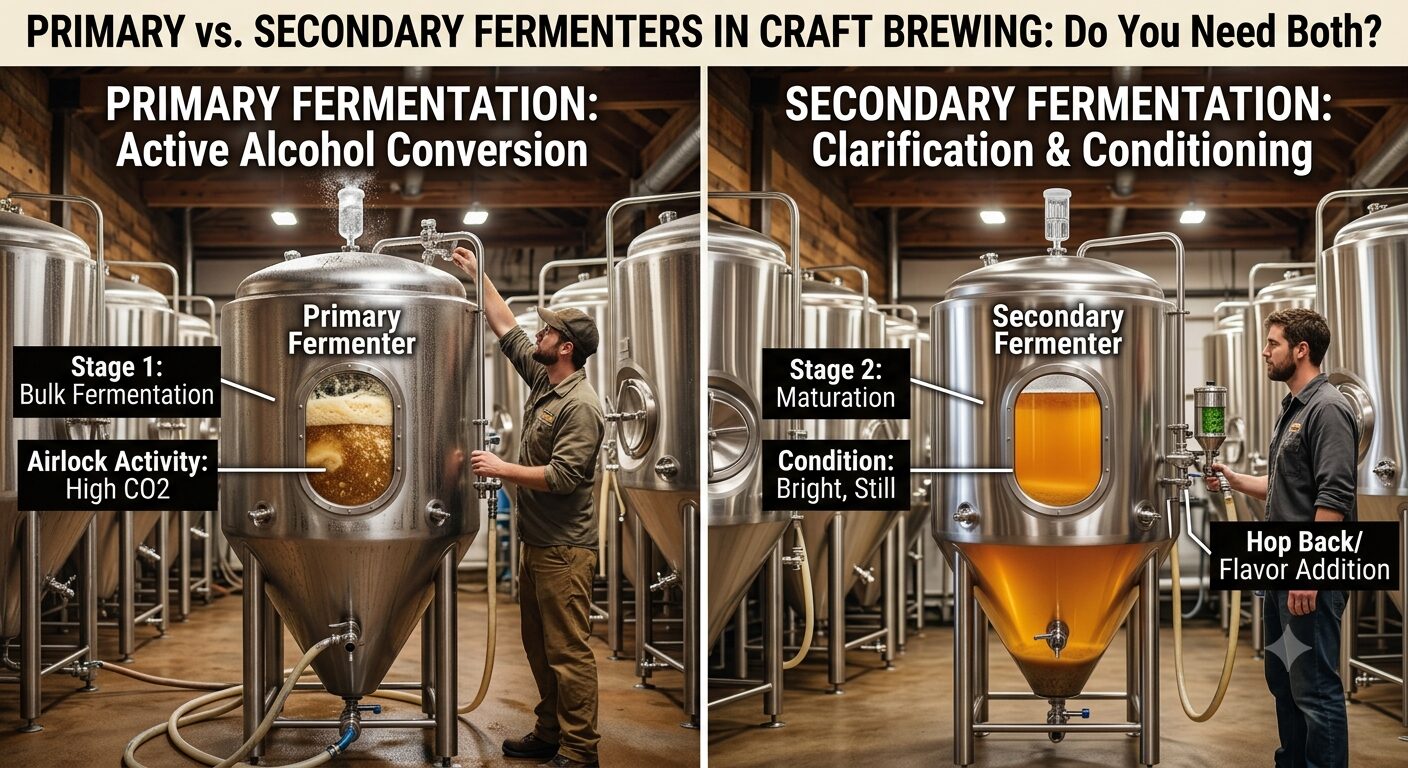
The first stage of cold-side work happens in a heavy-duty vertical fermentation tank built to handle strong yeast growth and a fast sugar drop.
This primary vessel has a classic rounded body and a steep cone base set at a sixty-degree inside angle.
As the yeast finishes the simple sugars and drops out of suspension, the steep slope uses gravity to pull the cells into a tight plug at the bottom tip.
This collection point lets cellar teams purge heavy trub and harvest healthy yeast without disturbing the main liquid.
But standard conical fermenters are usually low-pressure units, limited to under 5 PSI.
Because they cannot handle high gas pressure safely, you cannot fully force-carbonate finished beer in them with carbonation stones.
This limit means moving the beer to a separate bright tank, which shows the difference of a brite tank vs fermenter layout.
Let the Yeast Finish Its Flavor Cleanup
A quiet fermenter does not always mean the yeast has finished working.
Do not move a beer off its primary yeast right after the visible activity slows.
In the later stage, the yeast keeps cleaning up compounds that can taste buttery, green-apple, or sulfur-like.
This cleanup can continue even after the krausen falls and the airlock looks still.
Moving too early can leave too little healthy yeast in suspension, which slows attenuation or keeps unwanted byproducts.
Before moving the beer, confirm the gravity has stabilized and the flavor-cleanup period is done; lagers, high-gravity beers, and stressed batches may need more time.
Watching for Hop Creep After Dry Hopping
Dry hops do more than add aroma; they can wake the fermentation back up.
Dry hopping can restart fermentation even when the beer seemed to reach final gravity.
Enzymes from the hops break unfermentable compounds into sugars the leftover yeast can eat, an effect called hop creep.
This can cause a fresh gravity drop, more carbon dioxide, and new diacetyl precursors.
After dry hopping, keep the beer warm enough for the yeast to finish this renewed fermentation and cleanup.
Repeat gravity and taste checks before cold-crashing or packaging, and make sure the tank has enough pressure protection or venting for the new carbon dioxide.
Section 3: The Mechanical Role of a Dedicated Secondary Fermenter
A traditional secondary vessel is built for long aging, gentle flavor infusions, and natural clarification.
Moving green beer off the primary yeast cake into a dedicated secondary fermenter protects it from sitting on spent cells too long.
When yeast sits at the bottom of a big tank under heavy liquid weight, it suffers high osmotic and hydrostatic pressure.
This stress can rupture the cell walls, a destructive process called yeast autolysis.
Yeast autolysis releases rubbery, meaty, and soapy off-flavors into the beer, ruining the flavor.
Moving the beer to a clean secondary tank removes this risk, which is ideal for long lagering, wood-chip aging, or adding fruit and spices.
The main drawback of a two-stage transfer is the constant risk of picking up trace oxygen, which causes fast oxidation and shortens shelf life.
“Secondary” Is Often Really a Conditioning Stage
Despite its name, a secondary fermenter does not always hold an active second fermentation.
Most of the time the beer is simply resting, clearing, and developing its final character after primary fermentation.
Calling this stage conditioning, maturation, or lagering often describes it more accurately.
A true new fermentation begins only when you add fresh fermentable material or another active culture, like fruit sugars, priming sugar, fresh wort, or Brettanomyces.
Defining the vessel’s purpose before you buy it helps you pick the right pressure rating, temperature control, ports, and working volume.
Use a Closed Transfer to Protect the Beer
The transfer itself is usually the weakest point of a two-vessel process.
You can cut the oxidation risk of a secondary fermenter with a fully closed transfer.
Before the transfer, clean, sanitize, seal, and purge the receiving tank of air.
Let the beer enter through a lower sanitary port instead of splashing through the top manway.
A regulated carbon dioxide supply can keep gentle pressure on the sending tank while displaced gas leaves the receiving tank safely.
Sanitize the hoses, fill them with carbon dioxide or beer first, and check every clamp, valve seat, and sample port for leaks.
Adding Fining Agents During Conditioning
Time alone does not always give the clarity a brewery needs.
A secondary vessel is a controlled place to add fining agents when natural settling is not enough.
Depending on the beer, breweries may use gelatin, isinglass, or silica-based products to help yeast, protein, and haze settle.
Choose the product through small trials, because dosage, temperature, pH, contact time, and yeast strain all affect the result.
Add the fining agent through a sanitary port without splashing, then remove the settled sediment before packaging.
Also confirm labeling, allergen, and local rules for the processing aid you choose.
Section 4: Eliminating Transfers via High-Pressure Multi-Functional Unitanks
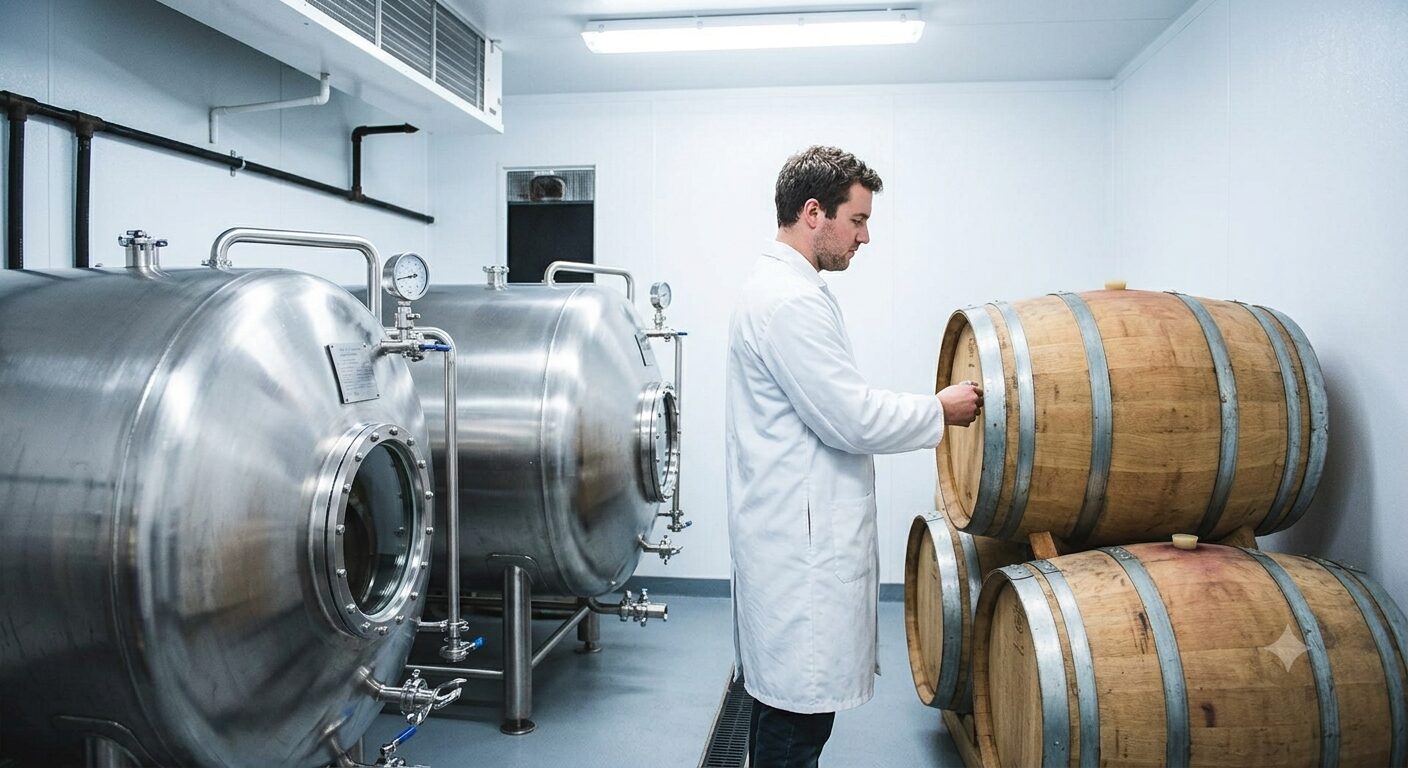
To solve the oxidation and flavor issues of two-stage cellaring without extra transfers, makers built the multi-functional unitank.
A unitank has the same vertical, cone-bottom shape as standard Conical fermenters but with thicker steel plates and reinforced support bands.
These upgrades let the vessel safely hold steady inside pressures of 15 to 30 PSI.
Working under pressure changes how a cellar team manages packaging timelines.
Brewers can close the gas arm near the end of the cycle to trap natural carbon dioxide in the beer.
This natural pressure carbonates the beer while keeping it safely away from harmful oxygen.
A unitank also has permanent sanitary ports for carbonation stones, rotating racking arms, and sample valves.
This lets you ferment, drop yeast, cold-crash, and fully carbonate in one sealed vessel with no extra transfers.
Section 5: Volumetric Sizing Milestones for Small and Large Operations
Every growing beverage company sizes its primary and secondary tanks around its brewhouse batches and sales volume.
For labs, small startups, or recipe teams, a compact 1 bbl fermenter is the standard pilot choice.
These small pilots let you check yeast performance and test new ingredients without risking a lot of raw material.
As a business grows into a neighborhood taproom, operators usually move up to a 5 bbl fermenter to supply their draft lines.
For startups launching with local wholesale draft accounts, a 7 bbl fermenter is the classic entry-level size.
Moving up to a 10 bbl fermenter gives growing taprooms the volume for expanded packaging, like mobile canning runs.
As local demand climbs, a 15 bbl fermenter or a heavy-duty 30 bbl fermenter gets the most from your labor.
Finally, a huge 90 bbl fermenter gives the volume to keep automated high-speed canning and bottling lines running.
Section 6: Cross-Industry Equipment Applications and Hybrid Operations
The core rules of temperature control, sanitation, and fluid transfer apply across all beverage industries.
In wine, a commercial wine fermenter uses wide shapes to manage the cap of grape skins during red wine maceration.
But white winemakers, cider producers, and mead makers often use vertical conical tanks that look just like beer gear.
This overlap lets microbreweries easily add small, niche beverages to their range.
Setting up a beer brewing fermenter for multi-beverage work needs very flexible temperature control.
To study how different yeast strains react to different vessel shapes, teams read the manuals of the Siebel Institute of Technology.
Mastering these fermentation dynamics helps your team keep quality high across every style.
Secondary Fermentation with Brettanomyces and Mixed Cultures
A secondary fermenter can also become a controlled home for Brettanomyces or souring cultures.
These are useful for beers that get Brettanomyces, Lactobacillus, Pediococcus, or another specialty culture after primary fermentation.
These organisms can keep changing attenuation, acidity, aroma, and flavor for several months.
So the tank needs stable temperature control, easy sampling, and a way to track gravity and flavor over a long period.
The bigger concern is cross-contamination: clearly label the vessel and use dedicated or color-coded hoses, gaskets, and sample valves.
Validate the cleaning process before that vessel goes back to clean-beer service.
Section 7: Metallurgical Standards and Bio-Security Compliance
The metal blend and inside finish of your tanks directly affect your beer’s shelf life and daily cleaning costs.
Commercial beverage tanks must be made from strong stainless steel, usually AISI 304 or acid-resistant AISI 316L.
These alloys have plenty of chromium and nickel, which form a self-healing protective layer on the surface.
This layer guards the tank against cleaning acids, high-chlorine water, and the natural acids in fruit and hops.
To stop bacteria, the inside steel must be polished very smooth, with a roughness of 0.8 micrometers or less.
Rough spots, welds, or scratches can hide wild yeast and shield it from a custom microbrewery fermenter cleaning run.
To set safe wash temperatures and protect your staff, the Master Brewers Association of the Americas (MBAA) offers full cellar safety guides.

Section 8: Primary and Secondary Engineering Matrix
Choosing between a split-vessel workflow and a single-tank unitank means weighing key technical and economic trade-offs.
The reference below shows the main mechanical differences across common cellar setups.
                              ┌──► Max pressure: low, under 5 PSI
[Standalone Low-Pressure CCT] ├──► Yeast autolysis risk: higher if beer is left on the cone
                              ├──► Oxidation risk: minimal during the primary phase
                              └──► Inline carbonation: no
                             ┌──► Max pressure: low to atmospheric
[Dedicated Secondary Vessel] ├──► Yeast autolysis risk: none (beer moved off the solids)
                             ├──► Oxidation risk: higher (from the transfer pipe links)
                             └──► Inline carbonation: no
                        ┌──► Max pressure: high, 15 to 30 PSI
[High-Pressure Unitank] ├──► Yeast autolysis risk: low (yeast dumped from the cone)
                        ├──► Oxidation risk: zero (sealed closed system)
                        └──► Inline carbonation: yes (via tri-clamp ports)
Section 9: Automated Clean-In-Place (CIP) Efficiency and Sterile Loops
Keeping perfect sanitation across your cellar is the single most important factor for your brand’s reputation and shelf life.
To clean these large vessels without hand scrubbing, plants use automated Clean-In-Place (CIP) loops.
The CIP setup uses a high-flow spray ball in the top dome to pump cleaning fluids across every inside surface.
A standard CIP run starts with a fresh-water pre-rinse to knock off heavy yeast cakes and loose material.
Next, a heated caustic (sodium hydroxide) solution runs through the loop at 60°C to 80°C to break down oils and proteins.
After a quick rinse, a phosphoric and nitric acid wash dissolves hard minerals like calcium oxalate scale.
To check the cleaning is working, quality teams use ATP bioluminescence swabs to confirm full sterility.
For advice on removing stubborn scale without scratching polished steel, producers follow the manuals of the Brewers Association.
Section 10: Building Layout Design and Concrete Floor Integrity
Planning an industrial cellar layout needs careful attention to your building size and concrete limits.
Buy your cellar vessels in exact volume multiples of your brewhouse output to keep the workflow smooth.
Leaving enough empty space at the top of the tank, called headspace or ullage, is a key safety factor.
As yeast breaks down sugars, it makes a thick, expanding layer of foam and protein called krausen.
If a tank is overfilled and lacks headspace, this foam can clog pressure relief valves and create dangerous pressure.
For standard ales, aim for at least 25 percent headspace; vigorous yeast strains may need up to 35 percent.
You must also check floor load limits, since a large full tank weighs several tons and needs thick reinforced concrete pads.
To keep your layout safe and correctly piped, follow the frameworks of the European Hygienic Engineering & Design Group (EHEDG).
Extra Headspace for Fruit and Other Additions
Fruit can turn a quiet secondary tank into an active fermenter again.
Fruit additions bring fermentable sugars and can restart yeast activity inside the secondary vessel.
So the tank must give enough temporary headspace for foam, fruit solids, and new carbon dioxide.
Keep a working blow-off or pressure-relief path until the gravity is stable again.
Add fruit purée, juice, or whole fruit through a sanitary method that limits oxygen and contamination.
Record the fruit’s sugar, the extra gravity drop, contact time, and final attenuation, and do not package until the renewed fermentation is finished.
Right-Sizing Headspace for Quiet Conditioning
A large foam allowance is essential during primary fermentation, but it can be a problem during quiet secondary conditioning.
The headspace that suits active fermentation is not always right for a secondary conditioning tank.
Once vigorous fermentation ends, the beer makes much less carbon dioxide and may not fill a large empty tank.
Too much secondary headspace can then raise the oxidation risk during long storage.
Size the secondary vessel as close as practical to the transferred beer volume, and purge the headspace with carbon dioxide after filling.
Keep extra headspace only when you plan to add fruit, sugar, or another ingredient that will restart fermentation.
Section 11: Real-Time Fermentation Tracking and Cellar Automation
The beverage market is adopting digital systems, turning traditional cellars into connected, data-driven networks.
Traditionally, a cellar worker had to draw a sample from every active tank daily to check the sugar drop with a glass hydrometer.
This manual process eats labor hours, wastes product, and adds a small contamination risk every time the valve is opened.
To fix this, modern facilities fit digital inline density sensors right into the tank walls.
These smart sensors use continuous pressure data or sound frequencies to track the sugar drop in real time and send alerts to the brewer’s phone.
If a batch slows down unexpectedly, the software warns the team early, so they can adjust temperature before the fermentation stalls.
To balance these high-tech systems with classic flavor, teams consult the Australian Wine Research Institute (AWRI) to study how process changes affect long-term aging.
Transfer by Terminal Gravity, Not a Fixed Date
Do not move a beer just because the recipe says seven or ten days have passed.
Base the transfer on fermentation performance, not a set number of days.
Terminal gravity is reached when the expected attenuation is done and back-to-back readings stay stable.
One batch may reach terminal gravity quickly, while another needs several extra days.
A short rest after terminal gravity also gives the yeast time to finish the flavor cleanup before you move the beer.
Record original gravity, final gravity, transfer date, temperature, sensory notes, and yeast condition to build reliable transfer standards per recipe.
Section 12: Blueprint for Operational Asset Allocation
Deciding between a two-stage process with a dedicated secondary fermenter and a single-vessel unitank needs a clear view of your packaging plans and cash flow.
For small, historic breweries focused on long wood-aging or clear lagers, separate primary and secondary tanks give a traditional, flexible path.
But for fast-growing packaging breweries where speed, labor, and oxygen control drive wholesale profit, high-pressure unitanks are the clear winner.
Check your building’s floor weight limits, plan plenty of headspace safety margin, and enforce strict automated CIP loops.
Pick the right setup for your volume, treat your cellar tanks as key partners, and your team can keep delivering great beer.
Using a Secondary Tank to Free Up Your Primary
One practical advantage of a secondary tank is that it frees the primary fermenter for another batch.
A secondary fermenter can improve cellar scheduling by releasing the primary vessel for the next production batch.
This helps when a beer needs only a week of active fermentation but several more weeks of conditioning, fruit contact, wood aging, or lagering.
But weigh this against buying another primary fermenter or a flexible unitank, because every transfer adds labor, chemicals, water, product loss, and contamination risk.
The best setup depends on your annual volume, average conditioning time, tank use, labor cost, and floor space.
Work out how many days each vessel spends actively fermenting versus just maturing to find the most economical mix.
Contact Us